
Measuring Plastic Mulch Residues in Fields
Summary
These soil sampling procedures quantify and track over time the plastic mulch fragments present in a field. Both soil-biodegradable as well as polyethylene mulch fragments can be sampled with these methods. The frame method provides consistent, repeatable sampling in the off-season, while the grab-soil method is used during the growing season.
Soil-biodegradable plastic mulch (BDM) can be a promising alternative to traditional polyethylene (PE) mulch, which fragments and persists in the field or surrounding environment. After the growing season, BDM is tilled into the soil, which mechanically breaks the mulch into fragments and distributes those fragments within the tilled layer (Yu and Flury 2021; Griffin-LaHue et al. 2022). Some fragments remain on the soil surface, others are incorporated into the soil to the depth of the tillage, and some can get entangled on the tillage implement. Over time, these BDM fragments continue to weather and become smaller until they reach the micro- and nanoparticle size range (1 µm to 5 mm, and <1 µm, respectively) and are then assimilated by microorganisms (biodegraded).
The rate of fragmentation and subsequent biodegradation varies among BDM products and field sites because they are influenced by film formulation, soil temperature and moisture, and other field conditions. The sampling procedures presented here are relatively simple, field-practical methods to quantify and track over time the BDM fragments present in a field. The frame method is adapted from the more intensive and high-accuracy approach described by Ghimire et al. (2020), and is streamlined to reduce labor and time demands while maintaining consistent, repeatable sampling. The grab-soil method is meant to be used during the growing season; small soil samples are collected from more sites in the field, providing a quick assay to track the degradation of mulch pieces.
How to Measure Plastic Mulch Fragments in the Soil
Quantification of mulch fragments after tillage is not straight-forward as fragments are randomly dispersed around the field and at various soil depths, down to the depth of tillage. The steps below emphasize representative sampling, consistent sampling depth, and standardized handling so results can be compared across dates and fields.
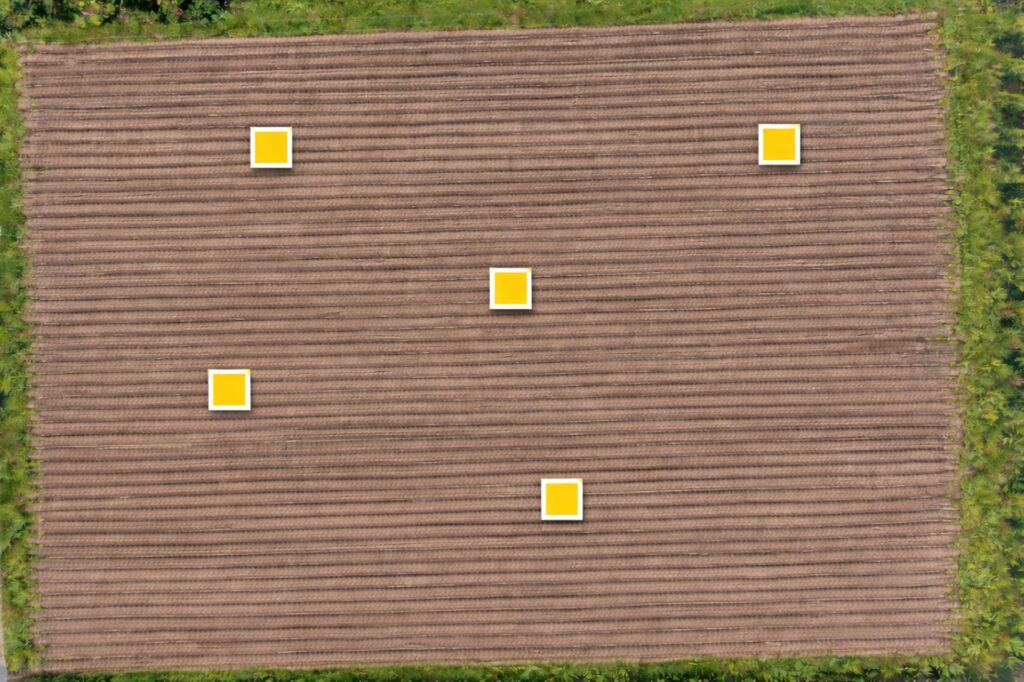
- Select sampling locations within a field in a random, representative manner by choosing at least five points dispersed across the field (Figure 1).
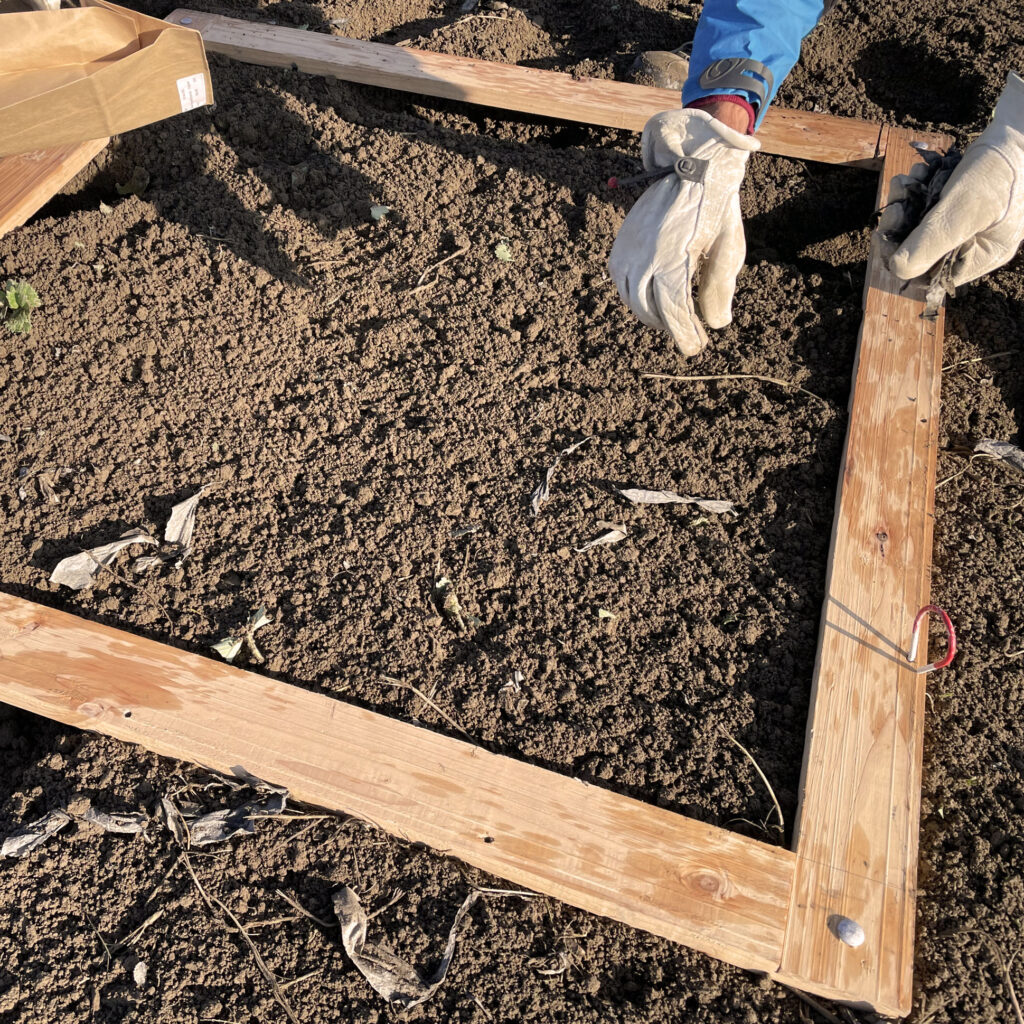
- Use a 1 m × 1 m wooden or PVC frame to define the sampling area (Figure 2).
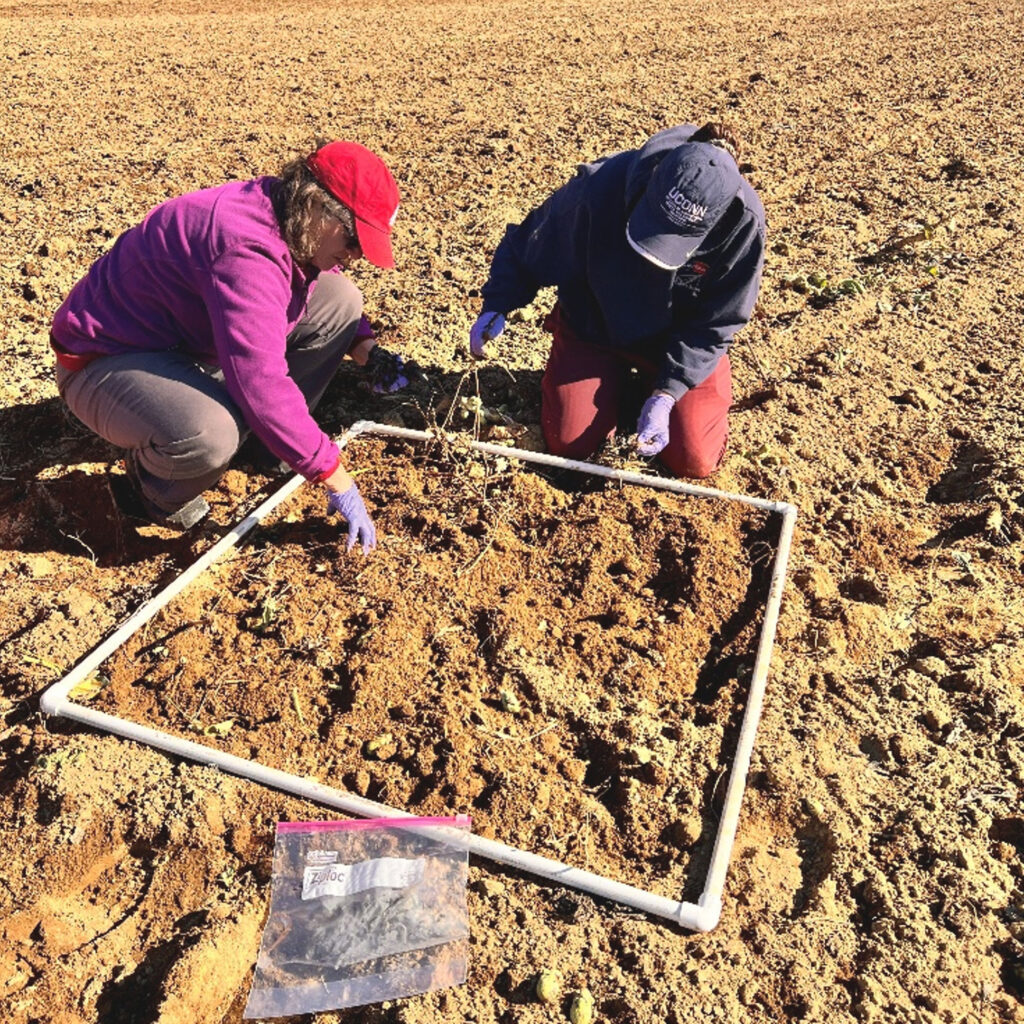
- Collect all visible mulch fragments from the soil surface within the frame. Lightly turn the top few inches by hand to recover buried pieces.
- Using a shovel, turn soil over to the tillage depth within the frame, collecting all visible mulch fragments as soil is inverted (Figure 3).
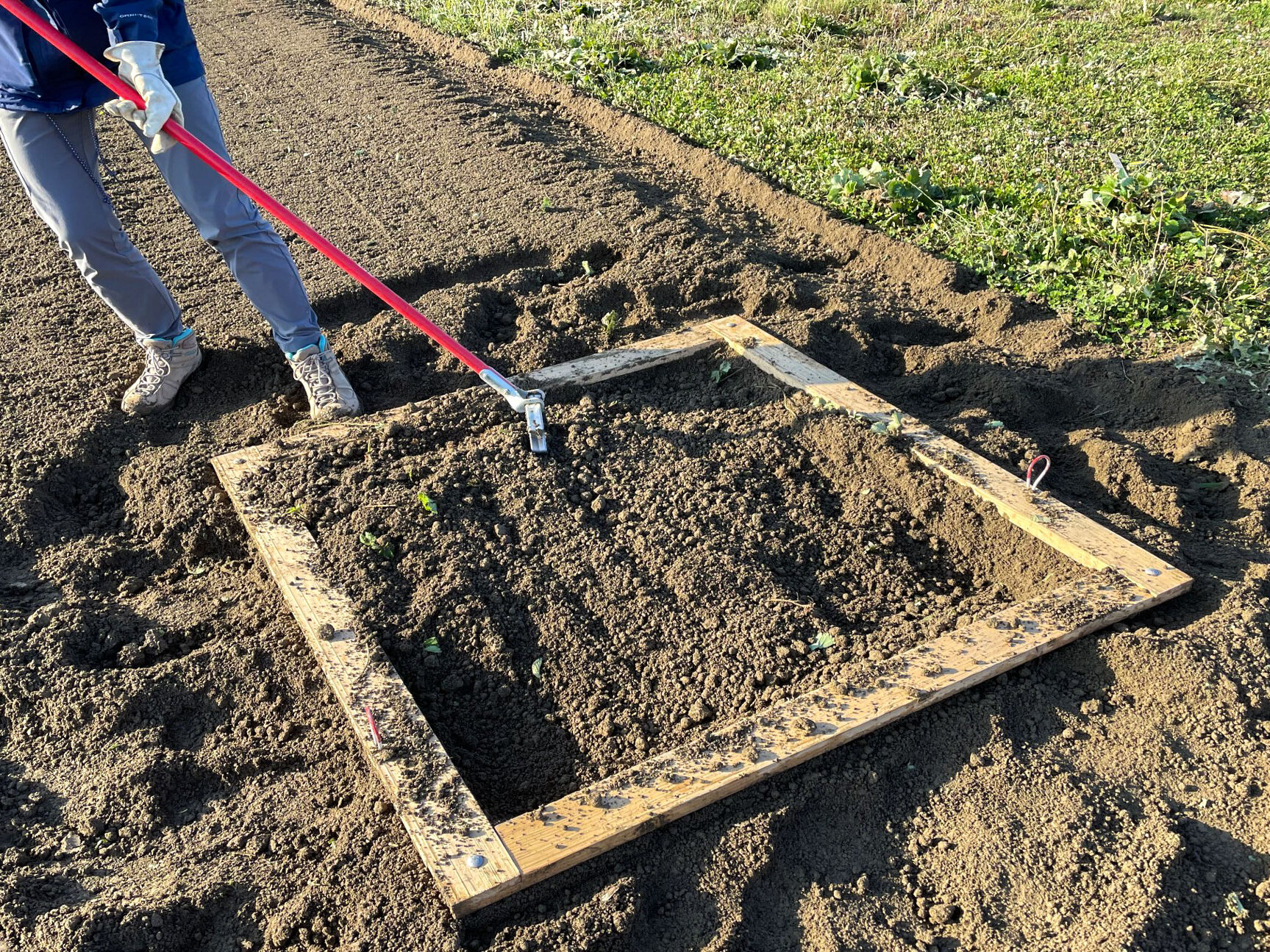
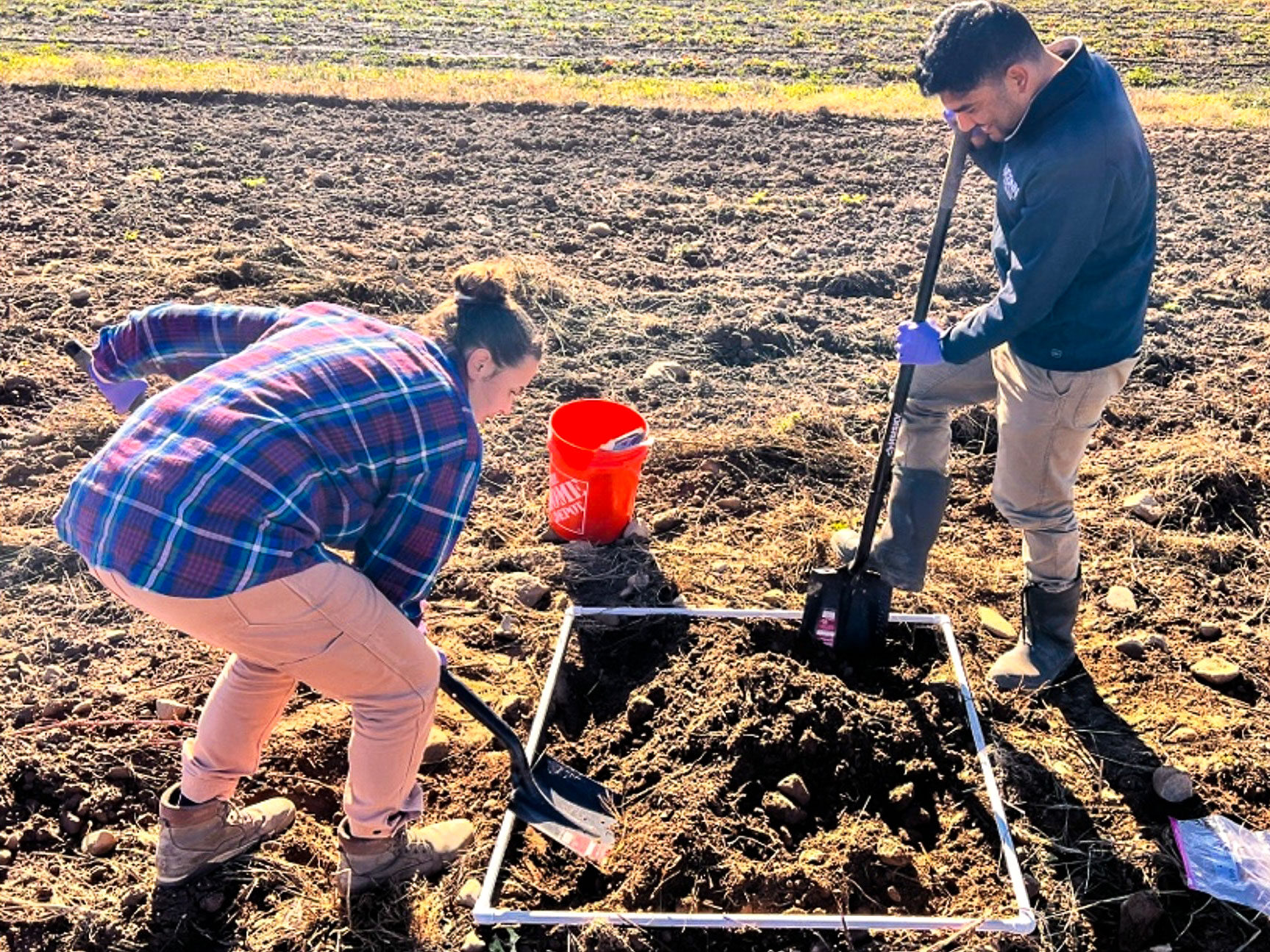
- Repeat this soil turnover until no more plastic fragments are visible; many turn overs may be required to ensure all fragments are collected from the sample area.
- Brush off adhered soil from fragments.
- Place all mulch fragments into a labeled bag; collect samples separately for each location in the field.
- In the farm shop or lab, clean and separate fragments into size categories macroplastics (>5 mm) and large microplastics (2–5 mm) by wet sieving:
- Place a 5 mm sieve on top of a 2 mm sieve and place under a faucet.
- Place the mulch samples into the 5 mm sieve and run the water to simultaneously wash and separate the fragments by size.
- Quantify collected mulch fragments in each sample:
- Place cleaned fragments on a white sheet of paper, cover with another sheet of white paper, and press with a weight (e.g., books) to flatten the fragments.
- Once the fragments are fully air-dried and flattened, photograph them with a digital camera:
- Place a ruler beside the fragments in each image to provide a reference scale for image analysis.
- Process images with ImageJ to quantify the surface area (see directions for processing images with ImageJ).
- Measure the dry weight of fragments in each size category – will be in grams or fraction of grams.
Rapid Test
A grab-soil sample method can be used to collect smaller size samples from more sites in a field. This protocol can be used anytime during the growing season to track the degradation of mulch pieces.
- Collect at least 10 samples per field, from sites dispersed throughout the field.
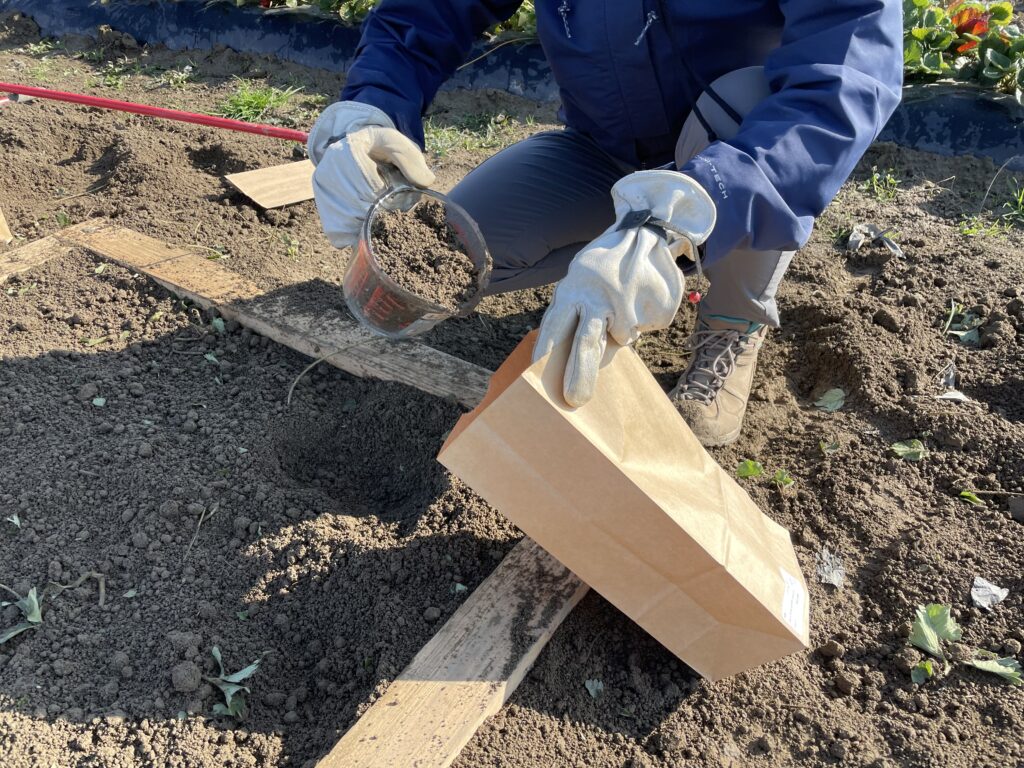
- For each sample, use a shovel to dig a hole to the tillage depth.
- Fill a 500 mL (2 cups) kitchen measuring pitcher with soil from the hole (Figure 4).
- Place soil from each site into a separate bag.
- Process the soil samples as described above for wet sieving, pressing, photographing, ImageJ analysis and weighing.
Mulch Fragments Collected in Field Soil Samples
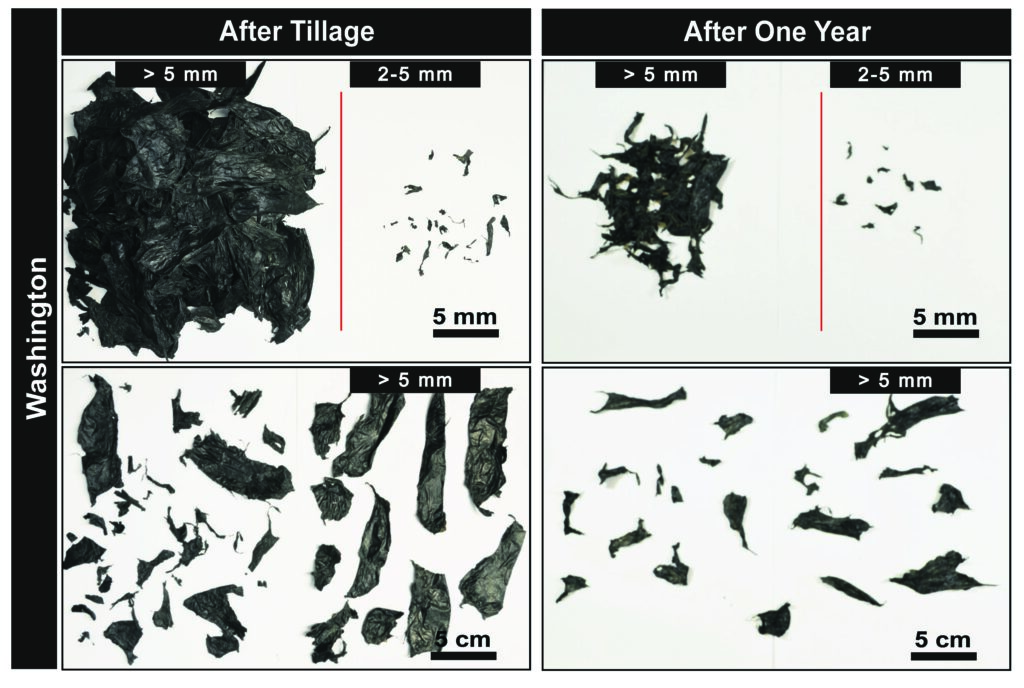
Figure 5 illustrates typical results from the frame sampling method, immediately after tillage and one year later. Immediately after tillage, BDM is usually present in a wide range of fragment sizes, varying from 2 mm to 15 cm. Most fragments are often larger than 5 mm, with few pieces in the 2 – 5 mm range. One year after tillage, fragments are typically fewer and smaller. The most prominent reductions often occur in the >5 mm size category, implying substantial deterioration of the BDM. This supports the intended function of BDMs, which are designed to break down over time under field conditions, minimizing long-term plastic accumulation.
References
- Ghimire, S., M. Flury, E. J. Scheenstra, and C. A. Miles, (2020), Sampling and degradation of biodegradable plastic and paper mulches in field after tillage incorporation, Sci. Total Environ., 703, 135577, doi:10.1016/j.scitotenv.2019.135577.
- Griffin-LaHue, D., S. Ghimire, Y. Yu, E. J. Scheenstra, C. A. Miles, and M. Flury, (2022), In-field degradation of soil-biodegradable plastic mulch films in a Mediterranean climate, Sci. Total Environ., 806, 150238, doi:10.1016/j.scitotenv.2021.150238.
- Yu, Y., and M. Flury, (2021), How to take representative samples to quantify microplastic particles in soil?, Sci. Total Environ., 748, 147166, doi:10.1016/j.scitotenv.2021.147166.
This material is based upon work that is supported by the National Institute of Food and Agriculture, under award numbers 2022-51181-38325 & 2016-51181-25404, Hatch Projects 7005372 and 7003737, and CPPM award 2021-70006-35582. Any opinions, findings, conclusions, or recommendations expressed in this publication are those of the author(s) and should not be construed to represent any official USDA or U.S. Government determination or policy. Additional support provided by WSARE under award 2019-51181-30012.

WSU Extension programs and employment are available to all without discrimination. Evidence of noncompliance may be reported through your local WSU Extension Office.