
PFAS are Not Present in Soil-Biodegradable Plastic Mulch
Summary
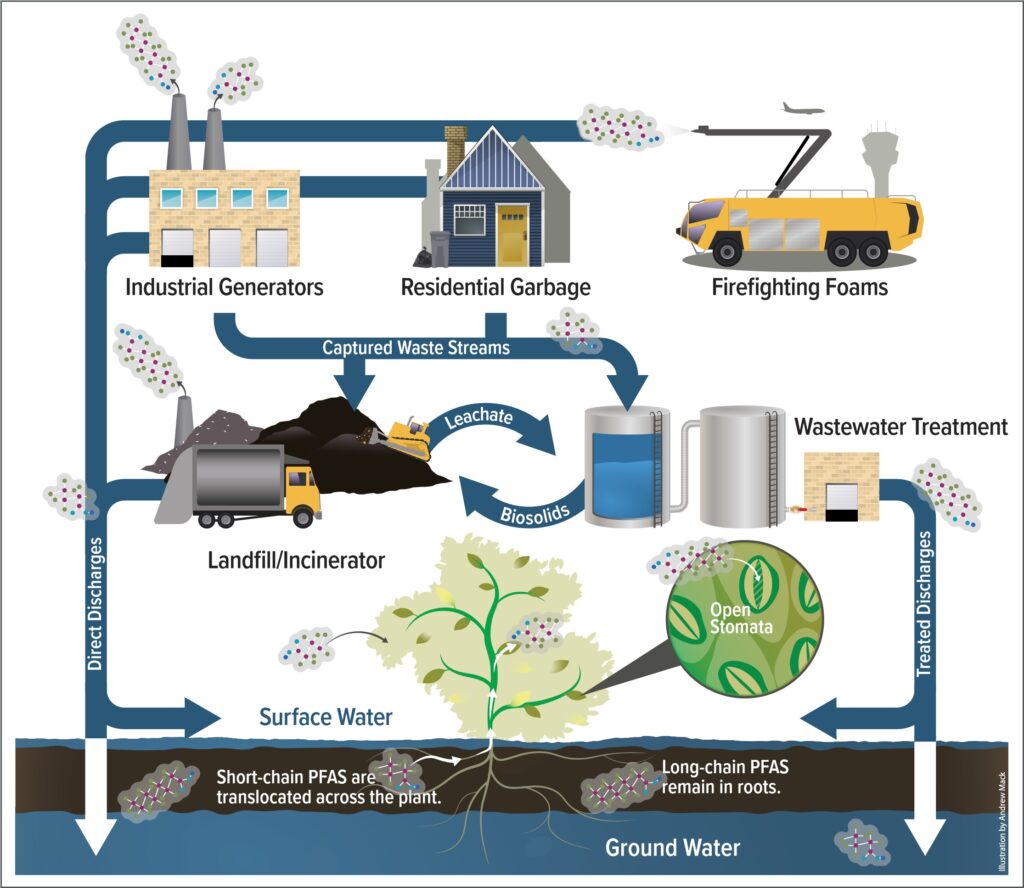
Soil-biodegradable mulch does not contain per- and polyfluoroalkyl substances (PFAS). Some potential souces of PFAS contamination in agricultural fields include sludge applications from papermills or wastewater treatment plants, and irrigation application of contaminated groundwater (from landfills or fire suppression foam for example). For those who have concerns about PFAS leakage into the environment, efforts should focus on mediating landfills, firefighting chemicals, and biosolid applications.
Soil-biodegradable plastic mulch (BDM) provides growers with a sustainable alternative to non-biodegradable polyethylene mulch as BDM can be tilled into the soil at the end of the growing season where it can fully biodegrade within several years (Griffin-LaHue et al., 2022). The question has been raised if BDMs release per- and polyfluoroalkyl substances (PFAS) into the environment when they biodegrade. PFAS are part of a large group of synthetic organofluorine chemical compounds also known as “forever chemicals.” They have been widely used in commercial and industrial products, including plastics, and are known for their resistance to grease, oil, water, and heat (NIH, 2023). There is increasing concern about sources of PFAS in the environment because some PFAS have been associated with negative health effects in humans and animals. PFAS are not used in the manufacturing of either plastic- or paper-based BDMs (D. Martens, vice president, Novamont North America; P. Sarazin, vice president for R&D and Sustainability, Poly Expert Corp., Montreal QC; personal communication, September 19, 2023). If PFAS contamination in agricultural fields and products are of concern, other sources of contamination should be considered given PFAS are not present in BDM.
There are several ways in which PFAS can be released into agricultural fields, potentially contaminating soil and water (Tallaksen, 2023). One notable pathway through which PFAS have been released into agricultural fields is the application of sludge from papermills or wastewater treatment plants as fertilizers or soil amendments, as these sludges contain high levels of PFAS (Miller, 2021). Another possible pathway is through the use of agrichemical formulations that have been phased out (EPA, 2023). According to the EPA, some agrichemicals used as non-food pesticides prior to 2022 may have potentially had PFAS as an inert ingredient, and application of such pesticides could have potentially contaminated soil and/or leached into groundwater.
Yet another probable source of PFAS contamination in agricultural fields is the use of contaminated groundwater for irrigation (Brown et al., 2020). The Maine PFAS taskforce found that groundwater was contaminated as a result of Class B Aqueous Film Forming Foam (AFFF) used during fire suppression and firefighter training sessions at fire stations where runoff likely leached into groundwater (Tipton et al., 2020).
Similarly, shuttered landfills have been shown to leak PFAS into surrounding groundwater (MPCA, n.d.). In Minnesota, nearly all shuttered landfills (98%) had PFAS contamination, with 31% of those sites having levels at least 10 times greater than the EPA health standard for drinking and groundwater, and two sites had contamination levels over 100 times greater than the EPA recommended limit (MPCA, n.d.).
The concerns about PFAS associated with the use of BDMs are unwarranted based on current knowledge. For those who have concerns about PFAS leakage into the environment, efforts should focus on mediating landfills, firefighting chemicals, and biosolid applications.
Works Cited
- Brown JB, Conder JM, Arblaster JA, and Higgins CP. 2020. Assessing human health risks from pr- and polyfluoroalkyl substance (PFAS)-impacted vegetable consumption: A tiered modeling approach. Environmental Science & Technology 54:15202-15214. doi: 10.1021/acs.est.0c03411
- EPA. 2023. Per- and polyfluoroalkyl substances (PFAS) in pesticide and other packaging. In: EPA (ed.). EPA.
- Griffin-LaHue D, Ghimire S, Yu Y, Scheenstra EJ, Miles CA, and Flury M. 2022. In-field degradation of soil-biodegradable plastic mulch films in a Mediterranean climate. Sci Total Environ 806:150238. doi: 10.1016/j.scitotenv.2021.150238
- Miller K. 2021. Trail of ‘forever chemicals’ leads to Maine paper mills, Portland Press Herald. The National Trust for Local News.
- MPCA. n.d. PFAS and closed landfills. In: MPCA (ed.). State of Minnesota.
- NIH. 2023. Perfluoroalkyl and polyfluoroalkyl substances. In: NIH (ed.). National Institute of Health and Environmental Health Sciences.
- Tallaksen J and Larson J. 2023. Forever chemicals may be a concern for agriculture. University of Minnesota, College of Food, Agriculture, and Natural Resource Sciences.
- Tipton M, Beal A, Belliveau M, Andre B, Farnham D, Graham L, Kraske C, Labbe N, Lambrew J, McBurnie J, and Reid J. 2020. Managing PFAS in Maine: Final Report from the Maine PFAS Task Force (pdf), January 2020. State of Maine.
This material is based upon work that is supported by USDA SCRI award 2022-51181-38325 and USDA OREI award 2021-51300-34909. Additional support was provided by the National Institute of Food and Agriculture Hatch project 1017286. Any opinions, findings, conclusions, or recommendations expressed in this publication are those of the author(s) and should not be construed to represent any official USDA or U.S. Government determination or policy.

WSU Extension programs and employment are available to all without discrimination. Evidence of noncompliance may be reported through your local WSU Extension Office.