Frequently Asked Questions about Soil-biodegradable Mulches
Summary
Growers and agricultural personnel have questions about several aspects of BDM, including its unpredictable breakdown and use in organic production. This provides the answers to frequently asked questions about BDM.
What are BDMs made of?
Plastic BDMs are made from feedstocks that are biobased, derived from fossil fuels, or a blend of the two. Biobased polymers can be extracted directly from natural materials such as starch and cellulose, produced by chemical synthesis from biologically derived monomers such as lactic acid that is polymerized to polylactic acid (PLA), and produced by microorganisms, such as polyhydroxyalkanoates (PHA) (Fig. 1). The most common fossil fuel-based polymers used are polybutylene-adipate-co-terephthalate (PBAT), polycaprolactone (PCL), polybutylene succinate (PBS), and polybutylene succinate adipate, and these are the most common components of plastic BDMs. All currently available plastic BDMs are manufactured by blending fossil fuel-based and biobased feedstocks, and biobased content currently ranges from 10% to a maximum of 50%.
Figure 1. Sources of biobased polymers
Starch, thermoplastic starch (TPS), and cellulose
TPS processed from high-amylose starch, cheaper than other starch feedstocks.
Synthetic polymerization of lactic acid into polylactic acid (PLA)
PLA produced relatively inexpensively compared to other biobased biopolymers.
Polyhydroxyalkanoates (PHA)
Poly(hydroxybutyrate) (PHB) and poly(hydroxyvalerate) (PHV) most important commercial PHAs.
Is soil-biodegradable mulch (BDM) certified for organic production?
According to criteria set by USDA National Organic Program (NOP), a mulch film must be completely biobased, and produced without the use of non-biobased synthetic polymers to be allowed for organic crop production. All currently available plastic BDMs are manufactured by blending fossil fuel-based and biobased feed-stocks, and biobased content currently ranges from 10% to a maximum of 50%, thus they are not allowed for use in organic production. Another limitation is the use of excluded methods, specifically genetically modified (GM) bacteria and yeast, for the fermentation of feedstocks to make biobased polymers. GM technology is not allowed in organic production. BDMs must also achieve ≥ 90% biodegradation in soil within 2 years according to ISO 17556 and ASTM D5988, which has not been demonstrated for all commercial BDMs across the diversity of climate, soil types, and production systems. However, paper BDM (e.g., WeedGuardPlus™) is allowed in organic production as it is made of 100% cellulose. Before using a mulch material in an organic operation, confirm its status with your organic certifier before application.
What is the impact of BDM on soil health?
Results to date show that soil health and soil biology are similar in plots treated with BDMs and PE mulch with no detrimental effects due to BDM incorporation. The research further shows that soil health measurements are impacted more by geographic location and season than by BDM application and incorporation. The longest study to evaluate effects of BDM on soil health is a four-year study in Washington State that showed no negative effects on soil health.
Do BDMs add organic matter to the soil?
When BDMs are tilled into the soil after the cropping season, the BDMs are broken down by microorganisms to microbial biomass, CO2, and water. So, it does not directly add organic matter to the soil. However, the waste products produced by microorganisms are also soil organic matter which is not so significant.
What are the storage conditions required for BDMs?
BDMs are susceptible to weathering and should be protected from exposure to temperature fluctuations, direct sunlight, precipitation, and high humidity to minimize mulch deterioration. Manufacturers recommend to not store BDM rolls for more than one year, otherwise the functionality may be reduced.
Do BDMs last over the cropping season?
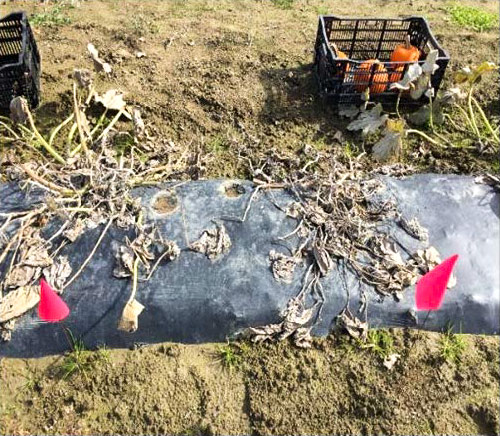
The longevity of BDMs during the cropping season depends on the thickness of the mulch product and the environmental conditions. Thinner products tend to deteriorate faster than thicker ones. High wind velocity, temperature and/or precipitation cause BDM to deteriorate faster irrespective of its thickness. Another factor that contributes to the longevity of BDM during the cropping season is plant growth habit, specifically canopy cover. For example, trailing vines or shoots that cover the mulch and have a broad canopy cover protect BDM from weathering and resulting deterioration compared to plants that grow upright and have minimal canopy coverage.
Because BDMs show unpredictable breakdown, are they as effective as conventional polyethylene (PE) mulches?
Weed control, soil temperature modification, and soil moisture conservation are the primary functions of mulch that lead to increased crop yield. BDMs have lower mechanical strength than polyethylene (PE) mulch, which leads to their faster deterioration several months after application. Depending on the environmental conditions and the thickness of BDM used, the longevity of BDM in the field differs. If the BDM breaks down mid to late in the cropping season, when the critical period of crop establishment and weed control are passed, crop yield is not affected. Research has shown comparable results between BDMs and PE mulch in terms of weed control, soil temperature modification, soil moisture conservation, and crop yield.
How expensive is BDM relative to PE mulch?
The purchase cost of BDM is almost two to three times greater than the cost of PE mulch. The cost of BDM depends on its thickness as the price increases with the increase in thickness. The use of BDM, however, reduces the cost of labor required to remove PE mulch at the end of the cropping season, and the disposal fees. Disposal fees may be significant depending on farm location. Labor costs also vary, with many agricultural production areas experiencing rising costs for farm labor and some having challenges sourcing enough labor. More research is needed to have a complete understanding of the net profit from crop production with BDM compared with PE mulch, but the economic impacts will vary based on the farming system and location. However, most studies to date suggest BDMs are an economic alternative due to labor savings from mulch removal and disposal. Please see Fig. 3 for an example of cost comparison.
| Particulars | PE Mulch | BDM |
|---|---|---|
| Cost of mulch/acre | $440.64 | $900.32 |
| Mulch installation/acre | $427.00 | $427.00 |
| Post harvest clean up cost/acre, includes PE mulch and drip tape removal, and haul to a disposal site | $515.00 | n/a |
| Drip tape removal/acre | n/a | $33.60 |
| Disposal cost/acre | $18.00 | n/a |
| Tillage for BDM incorporation | n/a | $22.40 |
| Total cost/acre | $1,400.64 | $1,383.32 |
Why use BDMs if it is more expensive than PE mulches?
Plasticulture took agricultural systems to the next level with increased crop yield and water conservation. The main drawback associated with PE mulch is resultant plastic pollution due to its non-biodegradability, which has adverse and long-term impacts on the environment and ecosystem. To reduce plastic pollution while maintaining crop productivity, BDMs were developed. The use of BDMs becomes more affordable when the cost of removal and disposal are taken into consideration, and the overall costs can be less in areas where labor and land-fill costs are relatively high.
Is laying of BDM different than that of PE mulch?
The same mulch laying equipment (mulch layer) can be used for both BDM and PE mulch, but a few adjustments need to be made when laying BDM as compared to PE mulch. Mulch is fed through the roller bars and then pulled out so that it passes under the guide wheels. For BDM, the roller bars should move freely so as not to put tension on the mulch. The guide wheels of the mulch layer should rest lightly on, or float just above the mulch. Tractor driving speed should start slow to avoid ripping of the BDM, especially if it is <1.0 mil thick. The BDM should be slightly loose on the bed when it is laid, as it will tighten up in a day or two, due to elastic properties of the plastic. If the film is applied too tightly on the bed, it may weaken as it tightens and/or be broken by soil clods. Once these adjustments have been made, growers have reported that the laying speed of BDM is equivalent to PE mulch.
Can BDMs be used as fumigation tarp?
No, BDMs are not currently on the Environmental Protection Agency’s (EPA) list of approved tarps tested for permeability that qualify for buffer zone reduction credits. BDMs can be applied after the fumigant’s REI has expired. They may also be applied during fumigation, but this practice is not recommended as it does not reduce the buffer zone around the perimeter of a field and fumigants may reduce the integrity of a BDM.
How to determine if a mulch product is biodegradable?
To determine if a mulch product is biodegradable, you need to consider the answers to the following questions:
- Does the mulch product label state that it meets the testing requirement of biodegradability criteria for BDMs, as outlined in EN 17033 and/or the ASTM D5988-18?
- Does the mulch product label state that it meets the compostable specifications of one of the following standards: ASTM D6400, EN 13432, EN 14995, or ISO 17088? If no, it is not compostable nor biodegradable.
- Is the mulch oxo- or photo-degradable? If yes, then it is not compostable nor biodegradable.
- Does the mulch film contain any polyethylene with an additive to make it biodegrade? If yes, it is fragmentable but not compostable nor biodegradable.
- Is the raw material used to make BDM certified by the Biodegradable Products Institute (BPI)? If no, you cannot say it is compostable in several states. If yes, is the mulch product also BPI certified or OK compost/soil certified? If no, then you cannot say it is biodegradable or compostable in several states.
Can photo- and oxo-degradable plastic mulches be used instead of BDMs since they are cheaper?
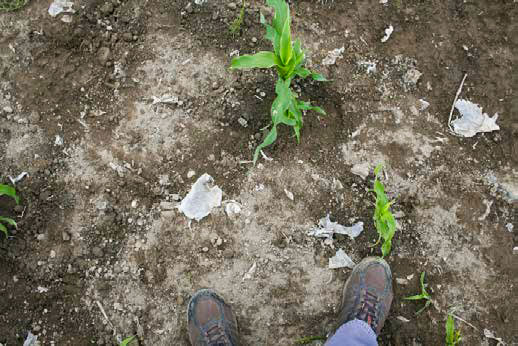
No, studies demonstrate that photo- and oxo-degradable plastics are not compostable nor biodegradable, thus when they disintegrate, they produce plastic fragments (microplastics). The advantage of BDM compared to PE mulch is that BDM is biodegraded by microorganisms to microbial biomass, CO2, and water, thereby reducing plastic pollution while maintaining crop productivity. Photo- and oxo-degradable plastic is made with conventional plastic: high density PE (HDPE), low density PE (LDPE), polypropylene (PP), polystyrene (PS), polyethyleneterephtalate (PET), or polyvinylchloride (PVC). Photo- and oxo-degradable plastic includes additives that cause the material to become brittle and break apart into fragments when exposed to UV light, heat and/or oxygen. These plastic fragments accumulate in soil and ocean environments, can absorb toxins, and can be transported up the food chain.
If a mulch product is completely biobased, is it readily biodegradable in the field?
Biobased only indicates the source of feed-stocks from which mulch products are made from and biodegradability does not depend on the source of feedstock. The inherent chemical properties of a polymeric material (e.g. chemical bonds) determines the susceptibility to breakdown by microbial action. For example, polylactic acid (PLA) is a biobased polymer that requires high temperatures for biodegradation. PLA therefore requires more time for breakdown in the field. On the other hand, polybutyrate adipate terephthalic acid (PBAT), whether fossil-based or partially biobased, is readily biodegradable due to its labile ester bond building blocks. It is important to remember that the biodegradability of a plastic mulch is not dependent on mulch biobased content. Increasing the biobased content in a BDM does not necessarily increase its biodegradability.
Resources
These information resources provide background information and additional information to help you have a more thorough understanding of this topic. We encourage presenters to view each one so as to be better prepared for your presentation.
- Biodegradable Plastic Mulch and Suitability for Sustainable and Organic Agriculture (FS103E)
- Oxo-degradable Plastics Risk Environmental Pollution
- Summary and Assessment of EN 17033:2018, a New Standard for Biodegradable Plastic Mulch Films (pdf)
- The Role of Standards for Use of Biodegradable Plastic Mulches: Truths and Myths (pdf)
- Video: Biodegradable Mulch Breakdown in Soil: Role of Microbiology
This material is based upon work that is supported by Western Sustainable Agriculture Research and Education, under award number WPDP19-05. Any opinions, findings, conclusions, or recommendations expressed in this publication are those of the author(s) and should not be construed to represent any official USDA or U.S. Government determination or policy

WSU Extension programs and employment are available to all without discrimination. Evidence of noncompliance may be reported through your local WSU Extension Office.