
Soil-Biodegradable Plastic Mulch for Organic Production Systems
Summary
Soil-biodegradable plastic mulch (BDM) can be a sustainable technology with several advantages over traditional plastic mulch, such as reducing labor costs for removal and disposal as well as a reduction in landfill waste. Biodegradation of BDMs under field conditions depend upon BDM feedstock, soil temperature, soil moisture, and soil microbial composition. Environmental factors affecting biodegradation include climate, soil type, pH, and other production practices. This fact sheet provides an update on the use of BDM in organic agriculture.
Soil-biodegradable plastic mulch (BDM) became commercially available in the 1990s. In October of 2014 the USDA National Organic Program (NOP) added BDMs to their list of allowed substances. Currently no commercially available BDM product meets the NOP requirements for organic production. NOP rules for BDMs include:
- Meeting the compostability specifications of one of the following standards: ASTM D6400, ASTM D6868, EN 13432, EN 14995, or ISO 17088 (all incorporated by reference; see § 205.3)
- Demonstrating at least 90% biodegradation in soil, according to one of the following test methods: ISO 17556 or ASTM D5988 (both incorporated by reference; see § 205.3)
- Being produced without organisms or feedstocks derived from excluded methods [(incorporated by reference; § 205.601(b)(2)(iii)]
- Comprised of 100% biobased content, determined using ASTM D6866 (incorporated by reference; see § 205.3); minor additives such as colorants and processing aids are not required to be biobased (NOP Policy Memo 15-1)
Plastic BDMs that do not meet these criteria cannot be used in organic agriculture. Commercially available BDMs that meet these criteria do not currently exist. The NOP disallows BDMs because BDMs will become incorporated into soil, whereas plastic mulches are removed from the field. In October of 2021 the National Organic Standards Board (NOSB) recommended the allowance of mulches made with 80% biobased feedstock. However, this rule has not been adopted by NOP and 100% biobased BDMs are still required in organic agriculture.
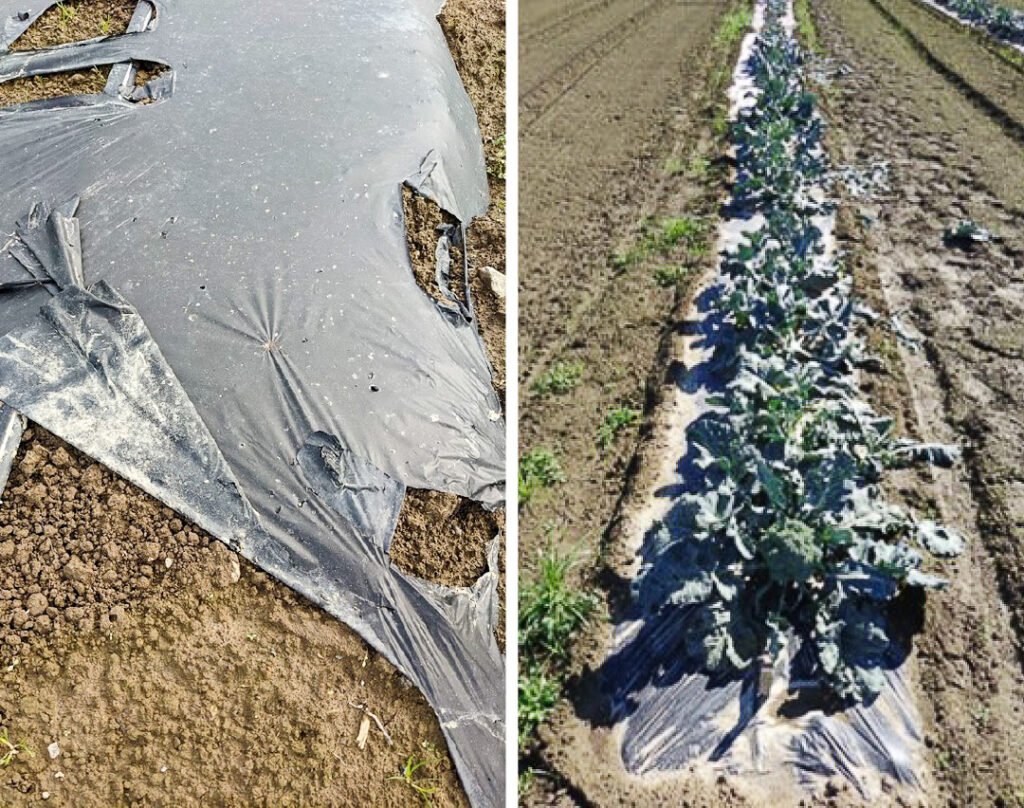
Mulch Biodegradation
Biodegradation of BDMs under field conditions depends upon its feedstock and soil microbes, temperature and moisture. Prevailing environmental factors that affect biodegradation include climate, soil type, pH, irrigation, and other production practices (e.g., tillage, cover cropping, chemical input application). The biobased content of a BDM indicates the source of the material that is used to make the mulch film. However, it is important to note that BDM biodegradation is not dependent upon its biobased content. Environmental weathering of the mulch film and the chemical properties of its feedstock (e.g., chemical bonds) influence the susceptibility of a BDM to biodegradation.
Growers will need to take appropriate action to ensure that proper degradation of the mulch is occurring; following till-down, BDM fragments must be well incorporated into the soil so they may breakdown. If an operation or grower uses practices that do not promote degradation, fragments of plastic mulch will accumulate in the environment over time.
Product Organic Compliance
There are several BDMs available in the U.S. and worldwide. Currently, no BDM made with plastic polymers has been approved for use in certified organic production because none meet the requirement of using 100% biobased feedstock. Non-biobased synthetic polymer feedstocks, such as petrochemical resins, are not permitted for organic agriculture. Similarly, feedstocks derived from or that utilize GM or GMO organisms are also not permitted.
Before using any product in a certified organic production system, check with your organic certifier to ensure that such use complies with your certification.
On-Going Research
University research programs are investigating the use and biodegradation of BDMs in fruit and vegetable crop production systems. To date, most research has shown yields of crops grown with BDMs are equivalent to when they are grown with polyethylene mulch. Special attention is currently focused on characterizing BDM degradation constituents and their fate, residence time, and potential for ecotoxicity effects to better understand their impacts in soil and aquatic environments. An overall goal of the research is to provide growers, crop consultants, manufacturers, and policy makers with data that can be leveraged to make informed recommendations. Research results will also provide growers with a guide of best management practices for the use of BDMs.
This material is based upon work that is supported by USDA SCRI award 2022-51181-38325 and WSARE award 2019-51181-30012. Additional support was provided by the National Institute of Food and Agriculture Hatch project 1017286. Any opinions, findings, conclusions, or recommendations expressed in this publication are those of the author(s) and do not necessarily reflect the view of the U.S. Department of Agriculture. Any opinions, findings, conclusions, or recommendations expressed in this publication are those of the author(s) and should not be construed to represent any official USDA or U.S. Government determination or policy.

WSU Extension programs and employment are available to all without discrimination. Evidence of noncompliance may be reported through your local WSU Extension Office.