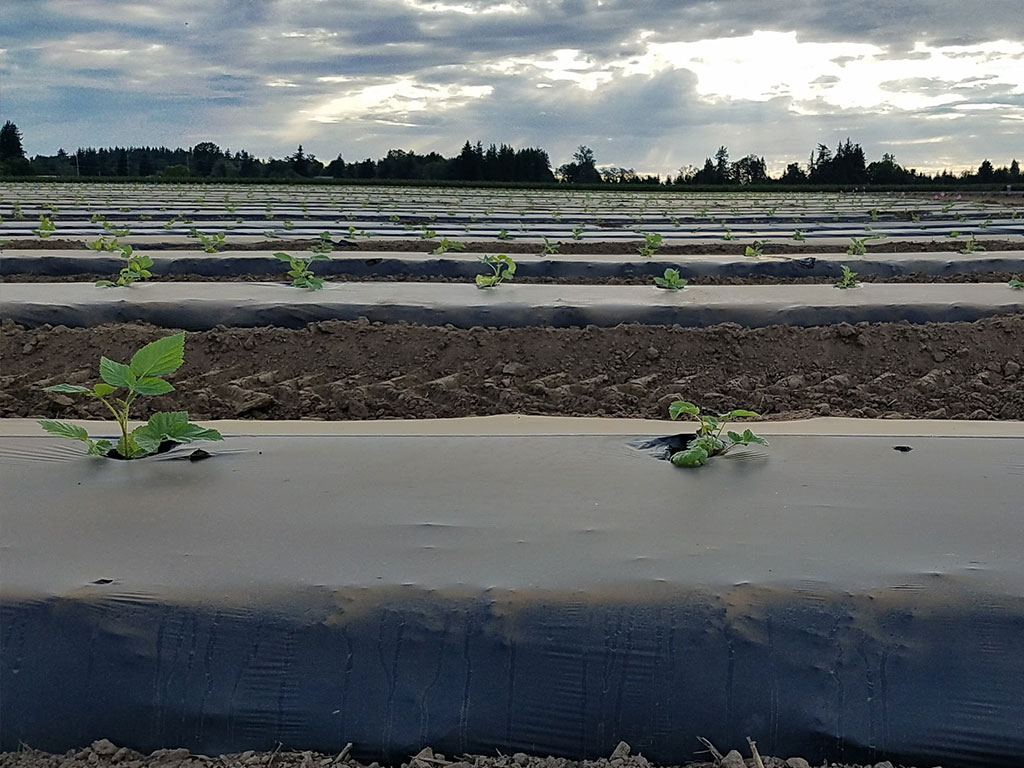
Impact of Biodegradable Plastic Mulch on Specialty Crop Production
Summary
Research on the efficacy of biodegradable plastic mulches (BDMs) has focused on its effects in vegetable and fruit crop production systems. This summary of research results provides a quick reference to the scientific literature on the use of BDM for vegetable and fruit crops. For some crops, several studies have been carried out in production systems around the world and findings may vary.
Research on the efficacy of biodegradable plastic mulches (BDMs) for specialty crop production has been ongoing for nearly two decades. Most of the published research has focused on BDM effects in vegetable production systems, and recently, scientists have been expanding BDM research to fruit crops. As the pace of BDM research and technological development quickens, scientists, growers, and crop advisors will benefit from ready references to the studies evaluating BDM in their systems of interest.
Table 1 presents a summary of research results found in the scientific literature on the use of BDM for crops. Martín-Closas et al. (2017) provide the most comprehensive review of the literature on BDM use in specialty crop production systems. The publications cited in that review and more recently published research are included in Table 1. Where multiple studies have been carried out on the same crop (e.g. BDM use in tomato systems worldwide), some researchers may have found positive impacts of BDM use, while others have found neutral or negative impacts. This information is reflected in Table 1, where “< = >” indicates that, among the studies reviewed, BDM use produced unfavorable “<”, comparable “=”, and favorable “>” results. Variable results occur because agricultural field research presents conditions that scientists are not always able to control. Thus, research results may vary substantially by region, climate, soil type, product formulation, and a host of other factors. Readers should be aware of these limitations. Many of the factors scientists, growers, and others may be interested in have yet to be systematically studied. Such a condition is noted in Table 1 by the “ɸ” symbol.
In some studies, BDM is compared to polyethylene (PE) or paper mulch (a “positive” control), while in other studies BDM is compared to bare ground (a “negative” control), or both. Additionally, studies vary in duration and may not evaluate crop response after multiple years of BDM use. We encourage the reader to review original publications to better understand the factors that may have impacted the results summarized here. Works cited numerically in Table 1 are presented in the Reference List following the table.
Quick reference to available published research on general impacts of biodegradable plastic mulch (BDM) use in specialty crop production1
| Crop | Crop yield vs. Bare ground | Crop yield vs. Paper mulch | Crop yield vs. PE 2 | Crop quality vs. Bare ground | Weed control vs. PE | References |
|---|---|---|---|---|---|---|
| Broccoli | > 3 | ɸ | ɸ | ɸ | ɸ | 1-3 |
| Christmas Tree | ɸ | ɸ | ɸ | ɸ | < | 4 |
| Cucumber | > | = | = | ɸ | = | 5-7 |
| Eggplant | > | ɸ | = | ɸ | < | 8 |
| Grape | > | ɸ | = | ɸ | ɸ | 4, 9-12 |
| Hazelnut | ɸ | ɸ | ɸ | ɸ | < | 4 |
| Lettuce | ɸ | ɸ | < = 4 | ɸ | ɸ | 1, 4, 13 |
| Melon | > | ɸ | = > | ɸ | = | 1, 14-24 |
| Pepper | < = | ɸ | = | = | < = | 8, 13, 25-27 |
| Pumpkin | > | = > | < = | < > | = | 28 |
| Raspberry | = > | ɸ | < = | > | ɸ | 29 |
| Strawberry | > | = > | < = > | = > | < = > | 4, 30-34 |
| Sweet Corn | > | ɸ | < = | ɸ | < | 8, 35 |
| Sweet Potato | > | ɸ | = > | ɸ | > | 36-37 |
| Tomato | > | > | = | = | < = | 13, 24, 38-54 |
| Zucchini | ɸ | ɸ | = | ɸ | ɸ | 4, 8 |
- Most information in this table is based on Martín-Closas et al. (2017), which summarized research results. More information is available in the original papers listed at the end of this fact sheet.
- Polyethylene mulch film.
- “ > ” BDM performed better; “ = ” BDM performed equivalent to; “ < ” BDM did not perform as well; “ ɸ ” nothing was mentioned.
- Reports that BDM had mixed results for the factor(s) listed. The reader should review the cited paper(s) to evaluate where deviations may have occurred.
References
Martín-Closas L, Costa J, Pelacho AM (2017) Agronomic effects of biodegradable films on crop and field environment. In: Malinconico M. (eds) Soil Degradable Bioplastics for a Sustainable Modern Agriculture. Green Chemistry and Sustainable Technology. Springer, Berlin, Heidelberg.
Broccoli (Brassica oleracea L. gp. Italica L.)
- Miles C, Klingler E, Nelson L et al (2007) Alternatives to plastic mulch in vegetable production systems. vegetables.wsu.edu/MulchReport07.pdf. Accessed 4 Sept 2016.
- Lopez-Marin J, Gonzalez A, Fernandez JA et al (2012) Biodegradable mulch film in a broccoli production system. Acta Hortic 933:439–444.
- Cowan JS, Inglis DA, Miles CA (2013) Deterioration of three potentially biodegradable plastic mulches before and after soil incorporation in a broccoli field production system in northwestern Washington. HortTechnology 23:849-858.
Christmas Tree (various genera and species)
- Minuto G, Pisi L, Tinivella F et al (2008) Weed control with biodegradable mulch in vegetable crops. Acta Hortic 801:291–297.
Cucumber (Cucumis sativus L.)
- Siwek P, Domagala-Swiatkiewicz I, Kalisci A (2015) The influence of degradable polymer mulches on soil properties and cucumber yield. Agrochimica 59:108–123.
- Wortman SE, Kadoma I, Crandall MD (2016) Biodegradable plastic and fabric mulch performance in field and high tunnel. HortTechnology 26:148–155.
- Haapala T, Palonen P, Tamminen A et al (2015) Effects of different paper mulches on soil temperature and yield of cucumber (Cucumis sativus L.) in the temperate zone. Agric Food Sci 24:52–58.
Eggplant (Solanum melongena L.)
- Waterer D (2010) Evaluation of biodegradable mulches for production of warm-season vegetable crops. Can J Plant Sci 90:737–743.
Grape (Vitis spp. L.)
- Minuto G, Pisi L, Tinivella F et al (2008) Weed control with biodegradable mulch in vegetable crops. Acta Hortic 801:291–297.
- Hostetler GL, Merwin IA, Brown MG et al (2007) Influence of geotextile mulches on canopy microclimate, yield, and fruit composition of cabernet franc. Am J Enol Vitic 58:431–442.
- Hostetler GL, Merwin IA, Br own MG et al (2007) Influence of undervine floor management on weed competition, vine nutrition, and yields of pinot noir. Am J Enol Vitic 58:421–430.
- Touchaleaume F, Martin-Closas L, Angellier-Coussy H et al (2016) Performance and environmental impact of biodegradable polymers as agricultural mulching films. Chemosphere 144:433–439.
- Touchaleaume F, Angellier-Coussy H, César Get al (2018) How performance and fate of biodegradable mulch films are impacted by field ageing. J Polym Environ 26(6):2588-2600.
Hazelnut (Corylus spp. L.)
- Minuto G, Pisi L, Tinivella F et al (2008) Weed control with biodegradable mulch in vegetable crops. Acta Hortic 801:291–297.
Lettuce (Lactuca sativa L.)
- Miles C, Klingler E, Nelson L et al (2007) Alternatives to plastic mulch in vegetable production systems. vegetables.wsu.edu/MulchReport07.pdf. Accessed 4 Sept 2016.
- Minuto G, Pisi L, Tinivella F et al (2008) Weed control with biodegradable mulch in vegetable crops. Acta Hortic 801:291–297.
- Lopez-Marin J, Abrusci C, Gonzalez A (2012) Study of degradable materials for soil mulching in greenhouse-grown lettuce. Acta Hortic 952:393–398.
Melon (various genera and species)
- Miles C, Klingler E, Nelson L et al (2007) Alternatives to plastic mulch in vegetable production systems. vegetables.wsu.edu/MulchReport07.pdf. Accessed 4 Sept 2016.
- Candido V, Miccolis V, Gatta G et al (2003) Innovative films for melon mulching in protected cultivation. Acta Hortic 614:379–386.
- Gonzalez A, Fernandez JA, Martin P et al (2003) Behaviour of biodegradable film for mulching in open-air melon cultivation in South-East Spain. Biodegradable materials and fiber composites in agriculture and horticulture. KTBL-Schrift, Darmstadt, pp 71–77.
- Lopez J, Gonzalez A, Fernandez JA et al (2007) Behaviour of biodegradable films used for mulching in melon cultivation. Acta Hortic 747:125–130.
- Incalcaterra G, Sciortino A, Vetrano F et al (2004) Agronomic response of winter melon (Cucumis melo inodorus Naud.) to biodegradable and polyethylene film mulches, and to different planting densities. Options Mediterraneennes 60:181–184.
- Vetrano F, Fascella S, Iapichino G et al (2009) Response of melon genotypes to polyethylene and biodegradable starch-based mulching films used for fruit production in the Western coast of Sicily. Acta Hortic 807:109–113.
- Iapichino G, Mustazza G, Sabatino L et al (2014) Polyethylene and biodegradable starch-based mulching films positively affect winter melon production in Sicily. Acta Hortic 1015:225–231.
- Martin-Closas L, Tura J, Rojo F et al (2010) Agronomic evaluation of a new generation of biodegradable mulch films of Mater-Bi® in a melon crop. In: Science and horticulture for people. 28th International Horticultural Congress. August Lisboa 2010. Abstracts, vol II, p 617.
- Filippi F, Magnani G, Guerrini S et al (2011) Agronomical evaluation of green biodegradable mulch on melon. Ital J Agron 6(e18):111–116.
- Saraiva A, Costa R, Carvalho L et al (2012) The use of biodegradable mulch films in muskmelon crop production. Basic Res J Agric Sci Rev 1(4):88–95.
- Benincasa P, Massoli A, Polegri L et al (2014) Optimising the use of plastic protective covers in field grown melon on a farm scale. Ital J Agron 9:8–14.
- Limpus S, Heisswolf S, Kreymborg D et al (2012) Comparison of biodegradable mulch products to polyethylene in irrigated vegetable, tomato and melon crops. Department of Agriculture, Fisheries and Forestry. Final report Project MT09068. Horticulture Australia Ltd., Sydney.
Pepper (Capsicum spp. L.)
- Waterer D (2010) Evaluation of biodegradable mulches for production of warm-season vegetable crops. Can J Plant Sci 90:737–743.
- Limpus S, Heisswolf S, Kreymborg D et al (2012) Comparison of biodegradable mulch products to polyethylene in irrigated vegetable, tomato and melon crops. Department of Agriculture, Fisheries and Forestry. Final report Project MT09068. Horticulture Australia Ltd., Sydney.
- Wortman SE, Kadoma I, Crandall MD (2015) Assessing the potential for spun-bond, nonwoven biodegradable fabric as mulches for tomato and bell pepper crops. Sci Hortic 193:209–217.
- Olsen JK, Gounder RK (2001) Alternatives to polyethylene mulch film, a field assessment of transported materials in capsicum (Capsicum annuum L.). Aust J Exp Agric 41:93–103.
- Moore JC, Wszelaki AL (2018) Pepper production on biodegradable mulches in the Southeast. HortScience (Pending Publication)
Pumpkin (Cucurbita spp. L.)
- Ghimire S, Wszelaki AL, Moore JC, et al (2018) The use of biodegradable mulches in pie pumpkin crop production in two diverse climates. HortScience 53:288-294.
Raspberry (Rubus spp.)
- Król-Dyrek K, Siwek P (2015) The influence of biodegradable mulches on the yielding of autumn raspberry (Rubus idaeus L.). Folia Horticulturae 27:15-20.
Strawberry (Fragaria spp. L.)
- Minuto G, Pisi L, Tinivella F et al (2008) Weed control with biodegradable mulch in vegetable crops. Acta Hortic 801:291–297.
- Scarascia-Mugnozza G, Schettini E, Vox G et al (2006) Mechanical properties decay and morphological behaviour of biodegradable films for agricultural mulching in real scale experiment. Polym Degrad Stab 91:2801–2808.
- Andrade CS, Palha MG, Duartec E (2014) Biodegradable mulch films performance for autumn-winter strawberry production. J Berry Res 4:193–202.
- Costa R, Saraiva A, Carvalho L et al (2014) The use of biodegradable mulch films on strawberry crop in Portugal. Sci Hortic 173:65–70.
- Daugaard H (2008) The effect of mulching materials on yield and berry quality in organic strawberry production. Biol Agric Hortic 26:139–147.
- DeVetter LW, Zhang H, Ghimire S et al (2018) Plastic biodegradable mulches reduce weeds and promote crop growth in day-neutral strawberries. HortScience 52:1700–1706.
Sweet Corn (Zea mays var. saccharata [Sturt.] L.H. Bailey)
- Waterer D (2010) Evaluation of biodegradable mulches for production of warm-season vegetable crops. Can J Plant Sci 90:737–743.
- Rajablarijani HR, Mirshekari B (2014) Sweet corn weed control and yields in response to sowing date and cropping systems. HortScience 49:289–293.
Sweet Potato (Ipomea batatas [L.] Lam.)
- Lee JS, Jeong KH, Kim HS et al (2009) Bio-degradable mulching for sweet potato cultivation. Korean J Crop Sci 54:135–142.
- Sideman RG (2015) Performance of sweetpotato cultivars grown using biodegradable black plastic mulch in New Hampshire. HortTechnology 25:412–416.
Tomato (Solanum lycopersicum L.)
- Limpus S, Heisswolf S, Kreymborg D et al (2012) Comparison of biodegradable mulch products to polyethylene in irrigated vegetable, tomato and melon crops. Department of Agriculture, Fisheries and Forestry. Final report Project MT09068. Horticulture Australia Ltd., Sydney.
- Wortman SE, Kadoma I, Crandall MD (2015) Assessing the potential for spun-bond, nonwoven biodegradable fabric as mulches for tomato and bell pepper crops. Sci Hortic 193:209–217.
- Martin-Closas L, Picuno P, Pelacho AM et al (2008) Properties of new biodegradable plastics for mulching, and characterization of their degradation in the laboratory and in the field. Acta Hortic 801:275–282.
- Martin-Closas L, Bach A, Pelacho AM et al (2008) Biodegradable mulching in an organic tomato production system. Acta Hortic 767:267–274.
- Martin-Closas L, Soler J, Pelacho AM (2003) Effect of different biodegradable mulch materials on an organic tomato production system. In: Biodegradable materials and fiber composites in agriculture and horticulture. KTBL-Schrift 414, Darmstadt, pp 78–85.
- Armendariz R, Macua JI, Lahoz I et al (2006) The use of different plastic mulches on processing tomatoes. Acta Hortic 724:199–202.
- Moreno MM, Moreno A (2008) Effect of different biodegradable and polyethylene mulches on soil properties and production in a tomato crop. Sci Hortic 116:256–263.
- Moreno MM, Moreno A, Mancebo I (2009) Comparison of different mulch materials in a tomato (Solanum lycopersicum L.) crop. Span J Agric Res 7:454–464.
- Anzalone A, Cirujeda A, Aibar J et al (2010) Effect of biodegradable mulch materials on weed control in processing tomatoes. Weed Technol 24:369–377.
- Cirujeda A, Aibar J, Anzalone A et al (2012) Biodegradable mulch instead of polyethylene for weed control of processing tomato production. Agron Sustain Dev 32:889–897.
- Macua JI, Jiménez E, Suso ML et al (2013) The future of processing tomato crops in the Ebro valley lies with the use of biodegradable mulching. Acta Hortic 971:143–146.
- Candido V, Miccolis V, Castronuovo D et al (2006) Mulching studies in greenhouse by using eco-compatible plastic films on fresh tomato crop. Acta Hortic 710:415–420.
- Candido V, Miccolis V, Castronuovo D et al (2007) Eco-compatible plastic films for crop mulching and soil solarisation in greenhouse. Acta Hortic 761:513–519.
- Miles CA, Wallace R, Wszelaki A et al (2012) Deterioration of potentially biodegradable alternatives to black plastic mulch in three tomato production regions. HortScience 47: 1270–1277.
- Cowan JS, Miles CA, Andrews PK et al (2014) Biodegradable mulch performed comparably to polyethylene in high tunnel tomato (Solanum lycopersicum L.) production. J Sci Food Agric 94:1854–1864.
- Cirujeda A, Anzalone A, Aibar J et al (2012) Purple nutsedge (Cyperus rotundus L.) control with paper mulch in processing tomato. Crop Prot 39:66–71.
- Cirujeda A, Aibar J, Moreno MM et al (2013) Effective mechanical weed control in processing tomato: seven years of results. Renew Agric Food Syst 30:223–232.
- Fontanelli L, Raffaelli M, Martelloni L et al (2013) The influence of non-living mulch, mechanical and thermal treatments on weed population and yield of rainfed fresh-market tomato (Solanum lycopersicum L.). Span J Agric Res 11:593–602.
- Ngouajio M, Auras R, Fernández RT et al (2008) Field performance of aliphatic-aromatic copolyester biodegradable mulch films in a fresh market tomato production system. HortTechnology 18:605–610.
Zucchini (Cucurbita pepo L.)
- Minuto G, Pisi L, Tinivella F et al (2008) Weed control with biodegradable mulch in vegetable crops. Acta Hortic 801:291–297.
- Waterer D (2010) Evaluation of biodegradable mulches for production of warm-season vegetable crops. Can J Plant Sci 90:737–743.
This material is based upon work that is supported by the National Institute of Food and Agriculture, under award number 2014-51181-22382. Any opinions, findings, conclusions, or recommendations expressed in this publication are those of the author(s) and do not necessarily reflect the view of the U.S. Department of Agriculture or U.S. Government determination or policy.

WSU Extension programs and employment are available to all without discrimination. Evidence of noncompliance may be reported through your local WSU Extension Office.