
Dimensions and Costs of Polyethylene and Soil-Biodegradable Plastic Mulch
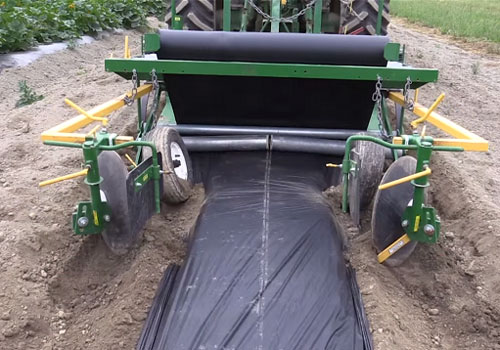
Farmers use mulch to control weeds, conserve soil moisture and help improve crop yield and quality. Information on mulch roll length, thickness, weight, and cost can help farmers determine whether soil-biodegradable plastic mulch (BDM) is a profitable option for their farm compared to polyethylene (PE) mulch. Table 1 compares this information for PE mulch and certified BDM products (supported by biodegradation testing and standards). Table 2 provides information regarding the number of bed feet per acre based on the distance between bed centers. This information is used to calculate the number of mulch rolls required per acre based on roll length (Table 3), and farmers can calculate cost of mulch based on price per roll and number of rolls needed. It is important to note that short roll length increases the cost of application if the farm is more than 1 acre as a new roll will need to be placed on the mulch laying machine more often.
At the end of the season, BDM can be tilled into the soil, which eliminates the cost of mulch removal, whereas PE mulch must be removed from the field and disposed of. Table 4 provides the time and cost associated with PE mulch removal, as well as the amount of soil removed with PE mulch. Removal time is based on a survey of Tennessee fruit and vegetable growers (Velandia et al. 2024), and removal costs are calculated using the 2025 median adverse effect wage rate ($17.74/hour) and a landfill fee of $17.8/acre for used PE mulch (assuming $58/ton; EREF 2024). The contamination of field-retrieved PE mulch ranged from 33 to 87% on a dry weight basis (Adesina et al. 2026). Field-retrieved PE mulch was oven-dried at 80 °C for 30 minutes, weighed, then washed four times at a temperature of 50–60 °C to remove adhered soil and debris, oven-dried at 80 °C for 30 minutes, and reweighed. Soil contamination was calculated as the difference between these two weights (other contaminant debris was very minor), expressed as a percentage of the initial dry weight including adhered soils and debris.
For a list of BDMs that are commercially available in the U.S. as of 2025, see Soil-Biodegradable Plastic Mulches (BDMs) Commercially Available in the U.S.
| Attribute | PE Mulch | Certified BDM |
|---|---|---|
| Available roll length1 | Up to 4,000 ft | Up to 8,000 ft |
| Available roll width1 | 3-6 ft | 3-6 ft |
| Roll thickness1 | 1.0-1.5 mil | 0.5-1.0 mil |
| Purchase cost (1,000 ft)2 | $21-$107 | $40-$175 |
| Weight (1,000 ft)1 | 15-36 lbs | 10-33 lbs |
| Allowed for certified organic production | Yes | No |
- Information is from mulch distributor websites and includes most commonly used dimensions as of 2026.
- Purchase costs are from mulch distributors and do not account for any discounts due to bulk orders, shipping charges, taxes and other fees; as of March 2026, purchase costs are for two certified BDM products.
| Spacing (bed center-to-center) | 1 acre | 3 acres | 5 acres | 10 acres |
|---|---|---|---|---|
| 5 ft | 8,712 | 26,136 | 43,560 | 87,120 |
| 6 ft | 7,260 | 21,780 | 36,300 | 72,600 |
| 7 ft | 6,223 | 18,669 | 31,115 | 62,230 |
| 8 ft | 5,445 | 16,335 | 27,225 | 54,450 |
| Roll Length (ft) | 5 ft spacing | 6 ft spacing | 7 ft spacing | 8ft spacing |
|---|---|---|---|---|
| 500 | 17.51 | 14.5 | 12.5 | 10.9 |
| 750 | 11.7 | 9.7 | 8.3 | 7.3 |
| 1,000 | 8.8 | 7.3 | 6.3 | 5.5 |
| 3,000 | 3.0 | 2.5 | 2.1 | 1.9 |
| 4,000 | 2.2 | 1.9 | 1.6 | 1.4 |
| 6,000 | 1.5 | 1.3 | 1.1 | 1.0 |
- Number of rolls presented in fraction to help farmers calculate the total number of rolls for more than 1 acre.
| Attribute | 1,000 bed feet | 1 acre1 |
|---|---|---|
| Time to remove mulch2 | 2.4 hrs | 17.25 hrs |
| Cost of field removal and disposal3 | $44 | $323 |
| Weight of mulch after removal from the field4 | 84 lbs | 610 lbs |
| Amount of soil (% by weight) on mulch after removal at the end of the season4 | 33-87% (~28-73 lbs) | ~200-530 lbs |
- 1 acre based on bed spacing 6 ft center-to-center.
- Time for PE mulch removal based on Velandia et al. (2024).
- Cost of PE mulch removal is based on 2025 median adverse effect wage rate of $17.74/hour, adding a $17.8/acre land field fee for used PE mulch (assuming $58/ton; EREF 2024).
- Weight depends on soil type and soil moisture content.
References
- Adesina, F. A., Englund, K. & Li, H. 2026. Impact of Soil Contaminants on Mechanical Properties of Recycled Agricultural Mulch Films. Cleaner Waste Systems (CLWAS-D-25-00539R4) (under review).
- Environmental Research and Education Foundation (EREF). 2024. Analysis of Municipal Solid Waste Landfill Tipping Fees – 2023.
- Velandia, M., S. P. Galinato, S. Shrestha, S. Ghimire, and L. DeVetter. 2024. Economics of Soil-Biodegradable Mulch Use (pdf). Washington State University Extension. Pullman, WA.
This material is based upon work that is supported by the National Institute of Food and Agriculture, under award numbers 2022-51181-38325 & 2016-51181-25404, Hatch Projects 7005372 and 7003737, and CPPM award 2021-70006-35582. Any opinions, findings, conclusions, or recommendations expressed in this publication are those of the author(s) and should not be construed to represent any official USDA or U.S. Government determination or policy. Additional support provided by WSARE under award 2019-51181-30012.

WSU Extension programs and employment are available to all without discrimination. Evidence of noncompliance may be reported through your local WSU Extension Office.