Oxo-degradable Plastics Risk Environmental Pollution
Summary
Oxo-degradable plastic is not biodegradable. When used as agricultural mulch, it breaks into fragments that can remain in the soil or surrounding environments for decades. These fragments become micro-particles that are pollutants in soil and water systems. The EU has banned products made with oxo-degradable plastics due to these environmental concerns.
Introduction
Three types of agricultural mulch films are commercially available:
- Conventional plastic mulch film composed largely of polyethylene (PE) and designed to be removed from the field after use,
- Biodegradable plastic mulch designed to be tilled in and biodegrade in the soil after use, and
- Oxo-degradable plastic that should be removed after use. Oxo-degradable plastic is made with conventional plastic such as polyethylene and includes pro-oxidant additives that cause the mulch to become brittle and break apart into non-biodegradable plastic fragments when exposed to sunlight, heat, and/or oxygen (EU Commission 2019).
The biodegradability of a plastic product is verified by the manufacturer by following the testing procedure specified by the applicable standard(s).
Distinction between Standards and Certifications
A standard is an internationally recognized guideline with specifications that ensure consistency, quality, and safety for a product. Standards include technical specifications, procedures or methods developed by recognized organizations or entities such as American Society for Testing and Materials International (ASTM), International Organization for Standardization (ISO), and European Standards (EN). The standard methods define how to test or evaluate specified properties of a product. For example, EN 17033 is a standard that specifies the requirements and test methods for soil-biodegradable mulch films in agriculture and ISO 17556 (equivalent to ASTM D5988) is a standardized laboratory test for measuring inherent biodegradability that is specified in EN 17033 (European Committee for Standardization 2018; International Organization for Standardization. 2019).
A certification is a formal recognition that a product meets one or more specific standards. It is granted by an independent certifying body after thorough testing.
The certification steps are:
- An existing standard defines the criteria and testing procedure is prescribed.
- Testing is conducted according to that standard.
- A certifying body evaluates the results and, if compliant, issues a certification.
- The product may now carry a label or mark, for example ‘TÜV OK biodegradable SOIL’.
Oxo-degradable Plastic Not Biodegradable in the Field
There is currently no recognized certification for oxo-degradable mulch films. However, there are standardized methods to compare and rank the rate of degradation under controlled laboratory conditions, but the results cannot be directly extrapolated to actual environments such as fields. Tests for oxo-degradable plastics’ degradation do not require that a certain percentage of degradation occurs within a specified time frame for a certain degradation environment. These tests describe methods, but they do not provide pass/ fail criteria. Yet, companies cite these tests to imply that their product has met international standards, which is misleading (FTC, 2015). Independent, third-party data using standard ASTM and ISO biodegradation tests that utilize soil show that no plastic fragments or only a small percentage of oxo-degradable plastic are utilized by soil microorganisms when oxo-degradable plastics are assessed (European Commission, 2017; Steinmetz et al., 2016). Even in laboratory environments conducted under carefully controlled temperature and light conditions, oxo-degradable plastics biodegrade very slowly. No laboratory test has shown more than 91% degradation in soil during two years, and some show that degradation stops completely when 13 – 65% degradation has occurred (European Commission, 2017; Steinmetz et al., 2016). In the United States, the Federal Trade Commission (FTC) has concluded that an oxo-degradable plastics manufacturer made false, misleading, and unsubstantiated claims regarding the biodegradation of its oxo-degradable plastics (FTC, 2015).
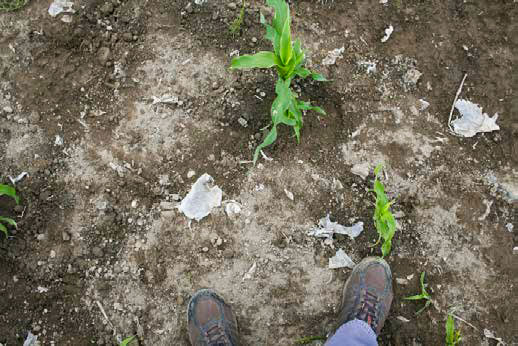
Macro and micro oxo-degradable plastic fragments accumulate in soil (Fig. 1) and aquatic environments, where they can absorb toxicants such as heavy metals and pesticides and form micro- and nanoplastics that can be transported up the food chain (European Commission, 2017). Further, studies demonstrate that oxo-degradable plastic is not compostable and is not suitable for anaerobic digestion (European Commission, 2017). When added to plastics for recycling, oxo-degradable plastic reduces the quality of plastics recyclate, but oxo-degradable plastic cannot be identified and separated in the plastic waste stream (European Commission, 2017).
Ban Called for Oxo-degradable Plastic
In the European Union (EU), the use of oxo-degradable plastics poses a risk of significant environmental damage (European Commission, 2017). Thus, the EU has officially prohibited products made from oxo-degradable plastic, including bags, packaging, and agricultural mulch film, for markets where composting, anaerobic digestion, or recycling are waste management options (European Commission, 2019). In the United States, the Ellen MacArthur Foundation, along with 150+ organizations have been calling for a ban on oxo-degradable plastic packaging (New Plastics Economy, 2019).
Farmers Be Aware
Farmers and agricultural suppliers must be aware that oxo-degradable plastic companies are selling oxo- degradable plastic mulch in North America. Manufacturers of oxo-degradable mulches have not provided any further evidence to demonstrate that these products meet standards that are used to establish inherent biodegradability of plastic products. Until third party evaluations show otherwise, farmers and agricultural suppliers should assume that oxo-degradable mulches are not biodegradable, compostable, or recyclable, and cannot be placed in anaerobic digesters. Therefore, oxo-degradable mulch films should be removed from fields after use, even if they are already in fragments, or they should not be used.
Moving Forward
To support long-term sustainability, farmers, agricultural suppliers, and Extension personnel must recognize that oxo-degradable plastic is not truly biodegradable and can contribute significantly to plastic pollution when left in the field. Despite claims made by manufacturers, oxo- degradable plastics do not biodegrade; they contribute to persistent plastic pollution in the soil and surrounding ecosystems. Only certified biodegradable products should be used to support sustainable and responsible plastic use.
References and Further Reading
- European Commission. 2017. Study to provide information supplementing the study on the impact of the use of “oxo-degradable” plastic on the environment. Final Report for the European Commission DG Environment. Eunomia Research and Consulting Ltd. DOI: 10.2779/081633
- European Commission. 2019. Directive (EU) 2019/904 of the European Parliament and of the Council of 5 June 2019 on the reduction of the impact of certain plastic products on the environment (Text with EEA relevance). Official Journal of the European Union. http://data.europa.eu/eli/dir/2019/904/oj. [accessed 10 Mar 2025].
- European Committee for Standardization. 2018. EN 17033: Plastics-biodegradable mulch films for use in agriculture and horticulture- requirements and test methods. Brussels.
- Federal Trade Commission. 2015. FTC concludes ECM BioFilms made false, misleading, and unsubstantiated claims about the biodegradability of plastic products treated with its additive. June 10, 2025. https://www.ftc.gov/news-events/news/press-releases/2015/10/ftc-concludes-ecm-biofilms-made-false-misleading-unsubstantiated-claims-about-biodegradability
- International Organization for Standardization. 2019. ISO 17556:2019 Plastics – Determination of the ultimate aerobic biodegradability of plastic materials in soil by measuring the oxygen demand in a respirator or the amount of carbon dioxide evolved.
- New Plastics Economy. 2017. Oxo-degradable plastic packaging is not a solution to plastic pollution, and does not fit a circular economy. June 10, 2025. https://www.ellenmacarthurfoundation.org/oxo-statement
- New Plastics Economy. 2019. New Plastics Economy Global Commitment Report (pdf). https://feconix.asia/wp-feconix/wp-content/uploads/2019/12/ GC-Report-June19.pdf. [accessed 11 Mar 2025].
- Steinmetz, Z., C. Wollmann, M. Schaefer, C. Buchmann, J. David, J. Tröger, K. Muñoz, O. Frör, G.E. Schaumann. 2016. Plastic mulching in agriculture. Trading short-term agronomic benefits for long-term soil degradation? Sci. Total Environ. 530:690-705. DOI: 10.1016/j.scitotenv.2016.01.153
This material is based upon work that is supported by the National Institute of Food and Agriculture, under award numbers 2022-51181-38325 & 2016-51181-25404, Hatch Projects 7005372 and 7003737, and CPPM award 2021-70006-35582. Any opinions, findings, conclusions, or recommendations expressed in this publication are those of the author(s) and should not be construed to represent any official USDA or U.S. Government determination or policy. Additional support provided by WSARE under award 2019-51181-30012.

WSU Extension programs and employment are available to all without discrimination. Evidence of noncompliance may be reported through your local WSU Extension Office.