Soil-Biodegradable Plastic Mulches (BDMs) Commercially Available in the U.S.
Summary
This factsheet provides information about commercially available soil-biodegradable plastic mulch (BDM) currently available in the United States, including polymers commonly used in their manufacture. Certified BDM products supported by biodegradation testing and standards are presented in one table, while commercially available BDMs without certification are listed in a separate table. Some products may claim to be allowable in organic farming, but to date none are allowed in the U.S.
Overview
The goal of this factsheet is to provide growers with clear and accessible information about soil-biodegradable plastic mulch (BDM) products currently available in the United States. This information was compiled from publicly available sources, including journal articles, supplier and manufacturer websites, and direct communication with suppliers and manufacturers. Certified BDM products supported by biodegradation testing and standards are presented in one table, while commercially available degradable mulches without soil-biodegradability certification are listed in a separate table.
All information is based on referenced sources and does not reflect direct user experience or evaluation. Some of the products listed may still be undergoing certification processes. The information provided is accurate to the best of our knowledge as of the publication date. Mention of product names is not an indication of university endorsement nor promotion. Some products may claim to be acceptable for use in organic farming, however, to date no soil-biodegradable or compostable plastics are allowed for use in USDA-certified organic production. Growers should always confirm approval with their specific certifier before applying any product to organic production.
Product Information
Commonly used polymers in commercially available biodegradable plastic films include TPS, PCL, PBAT, PHA, PLA, and PBS (see definitions in Table 1). Some biodegradable polymers are biobased while others are not. For example, TPS (thermoplastic starch) is biobased, and PBAT (poly(butylene adipate-co-terephthalate)) is not biobased, though both are biodegradable and free of phthalates. One notable resin, Mater-Bi, is composed of PBAT and TPS and is fully biodegradable and compostable.
Table 1
Common Polymers in Biodegradable Plastic
| Acronym | Polymer |
|---|---|
| TPS | Thermoplastic starch |
| PCL | Poly(ε-caprolactone) |
| PBAT | Poly(butylene adipate-co-terephthalate) |
| PHA | Polyhydroxyalkanoates |
| PLA | Polylactic acid |
| PBS | Polybutylene succinate |
Table 2 and Table 3 present key product information and characteristics for the BDMs. The following descriptions define column headings for these two tables.
Product is the commercial name of the soil-biodegradable plastic mulch (BDM). U.S. Supplier is the company responsible for distributing the product. Polymer or resin is unshaped raw material(s) used to manufacture plastic films as reported by the source or manufacturing company. Selected product information includes the product attributes listed on the suppliers’ website, such as color options and degradation timelines.
Certification refers to the process by which an independent, third-party organization verifies that a polymer or a product meets specific claims or standards. For soil-biodegradable plastics, one of the most widely accepted certifications is the ‘Biodegradable SOIL’ certification issued by TÜV Austria. Another certification widely used in Europe is ‘Biodegradable in soil’ issued by DIN CERTCO under DIN EN 17033. It is important to note that if a biodegradable plastic is certified as compostable, this does not mean that is soil-biodegradable. It is also important to note that while ASTM International (formerly the American Society for Testing and Materials) has standards like ASTM D6400 for compostable plastics, the U.S. does not have a standard or certificate for soil-biodegradable plastics and so only European certifications are available.
It is also important to distinguish between certification, testing, and standards. Certification involves independent verification, testing refers to the procedures and methodologies used to evaluate a product, and standards define the specific criteria a product must meet. Certification information in our tables is presented by the manufacturer on their website or provided through direct communication with company representatives.
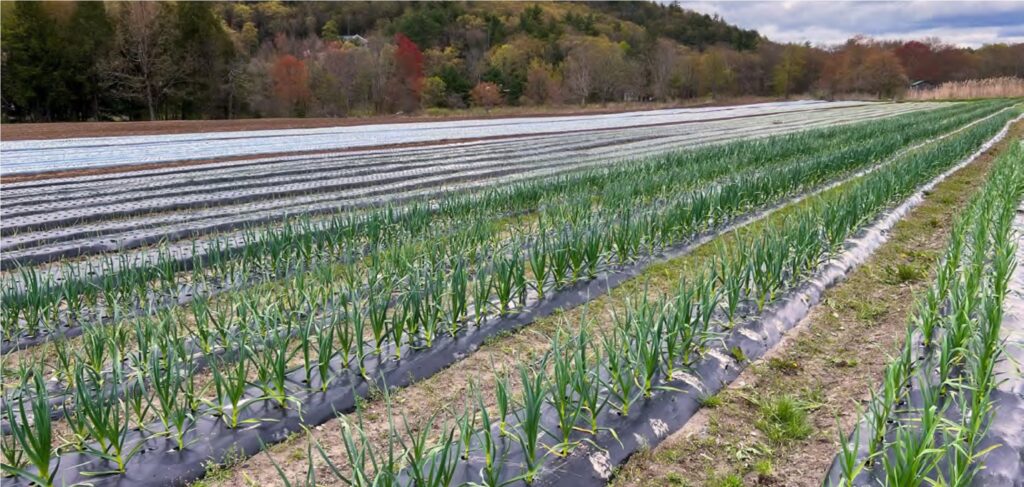
Soil-Biodegradable Plastic Mulches with Relevant Certification in the United States
The mulch products in Table 2 are certified BDM products supported by biodegradation testing and standards.
Table 2
List of soil-biodegradable plastic mulch products marketed in the United States with reported soil-biodegradability certification information.
| Product Namei | U.S. Supplier(s)i | Polymer or resin | Certification Statusii | Selected product information |
|---|---|---|---|---|
| BioGuard |
|
|
| Black, white-on-black, and gray-on-black. Supplier claims that degradation begins after about 4-5 months for 0.6-mil mulch and 5-6 months for 0.8-mil mulch, depending on climate. |
| Biosol | SPR Packaging, Rockwall, TX |
|
| Supplier information did not specify color options or expected field life. |
| Reyfilm Bio | SPR Agri, Rockwall, TX |
|
| Black, white/black, and clear. 0.6-mil mulch marketed for 2- to 6-month crops and 0.8-mil mulch for 9- to 12-month crops. |
| Bio360 |
|
|
| Available in several colors and sizes. The primary feedstock has soil-biodegradability certification, but the finished Bio360 mulch has not obtained product-level soil-biodegradability certification. |
- Product names and suppliers are included for educational purposes only; the list may not be exhaustive and does not imply endorsement.
- Certification status and product claims are subject to change and should be verified.
Biodegradable Plastic Mulches without Relevant Certifications in the United States
There are biodegradable plastic mulches without relevant certifications being marketed in the U.S. and we recommend caution using such products as they may not be soil-biodegradable. Some of the products listed in Table 3 may still be in the process of obtaining certification and may or may not be soil-biodegradable. If you have had a positive experience with a product that has not yet been certified, we do not discourage its use.
Some of these products are certified compostable, but compost conditions are not equivalent to soil conditions. Other products that are not listed here are made with polyethylene and starch, such that when the starch biodegrades the polyethylene pieces remain. Some products also not listed are oxo-degradable and these are often incorrectly marketed as biodegradable, but they do not biodegrade in soil, and contribute to microplastic generation. Oxo-degradable plastic has been banned in Europe. For more information regarding Oxo-degradable plastic mulches, see Oxo-degradable Plastics Risk Environmental Pollution.
Table 3
List of Plastic mulch products marketed in the United States without reported soil-biodegradability certification for the finished product.
| Producta | U.S. Supplier(s)a | Material information | Certification status |
|---|---|---|---|
| Bio-Gold |
| Not specified |
|
| Film Organic |
| Not specified |
|
| Film Organic Solafilm |
| Not specified |
|
| Sotrafilm Biodegradable |
| Biopolymer film containing biodegradable and renewable raw materials |
|
| Organic Guard |
| Made from corn, biodegradable bioplastics, and minerals |
|
- Product names and suppliers are included for educational purposes only; the list may not be exhaustive and does not imply endorsement. Product availability and certification status are subject to change; users should verify current documentation before purchase or use.
Use Caution Advisory Statement
All information provided is based on referenced sources and does not reflect direct user experience or product evaluation. The inclusion of product names does not imply endorsement or promotion by the university. Organic growers should always confirm approval with their specific certifier before applying any product to organic production. We advise caution when using products that lack certification regarding soil-biodegradability. Mulch manufacturers and suppliers should have their products tested by a third-party entity to ensure their product is fully soil-biodegradable and is not contributing to plastic pollution.
Practical Tip for Growers
- Confirm certification. Ask for documentation of the exact certification and film thickness. Keep records on file.
- Avoid oxo‑degradable plastics. These are not the same as biodegradable and they fragment into microplastics.
- Match film to crop and season. Consider durability needed for your climate and crop cycle length.
- Field test before scaling-up. Existing standards, certification, and research should reduce the need for every grower to conduct extensive on-farm testing. Where local conditions or product performance are uncertain, trial a few beds in your soil and climate to verify laying, planting, and in season performance.
- Check storage history and product age. Before purchase, confirm proper storage conditions and request the manufacturing date; BDMs may lose strength during storage, and products are best used within 2 years of receipt, with manufacturing date ideally no more than 6 months before delivery.
- Talk with your certifier. Policies and allowances can change; confirm use in your production system.
Acknowledgements
Special thanks to Dan Martens, Pierre Sarazin, and Trevor Hardy for their valuable insights and constructive feedback that contributed to strengthening this factsheet.
Useful Links
For more information, you can visit the following online resources that are links to external sites, which are provided for the convenience of readers. The University of Connecticut and Washington State University do not manage, control, or take responsibility for the content of external sites. These external sites do not implicitly or explicitly represent official positions and policies of either university.
Bio360
- Dubois Agrinovation. User Manual (pdf; available in French, English, and Spanish).
- Dubois Agrinovation. Compostable mulch film descriptions.
- Berry Hill Irrigation. Sales catalog 2025.
- Berry Hill Irrigation. Bio360 black information.
- Berry Hill Irrigation. Bio360 white on black information.
- Brookdale Farm Supplies. 2025 catalog.
BioGuard
- Nolt’s Produce Supplies. Sales catalog 2025 (pdf).
- PolyExpert. User manual (pdf; available in English, Spanish, and French).
FilmOrganic
Biosol
Reyfilm Bio
FilmOrganic Solafilm
Bio-Gold
Sotrafilm Biodegradable
Organic Guard
Reference
- Ghimire, S., Miles, C., Galinato, S. P., Wortman, S. E., & Velandia, M. (2026). Soil-biodegradable Plastic Mulches: Certification Status and Economic Considerations for Growers and Extension Professionals in the United States. HortTechnology, 36(5), 1049–1057.
This material is based upon work that is supported by the National Institute of Food and Agriculture, under award numbers 2022-51181-38325 & 2016-51181-25404, Hatch Projects 7005372 and 7003737, and CPPM award 2021-70006-35582. Any opinions, findings, conclusions, or recommendations expressed in this publication are those of the author(s) and should not be construed to represent any official USDA or U.S. Government determination or policy. Additional support provided by WSARE under award 2019-51181-30012.

WSU Extension programs and employment are available to all without discrimination. Evidence of noncompliance may be reported through your local WSU Extension Office.