
What is a Soil-Biodegradable Plastic Mulch Composed Of?
Summary
Soil-biodegradable mulches (BDMs) are increasingly used in agriculture to replace conventional plastic mulch and reduce waste and disposal challenges. BDMs are designed to be tilled into the soil after use at the end of growing season. Growers and agricultural professionals have questions regarding the formulation of BDMs. This is an introduction to what BDMs are made from.
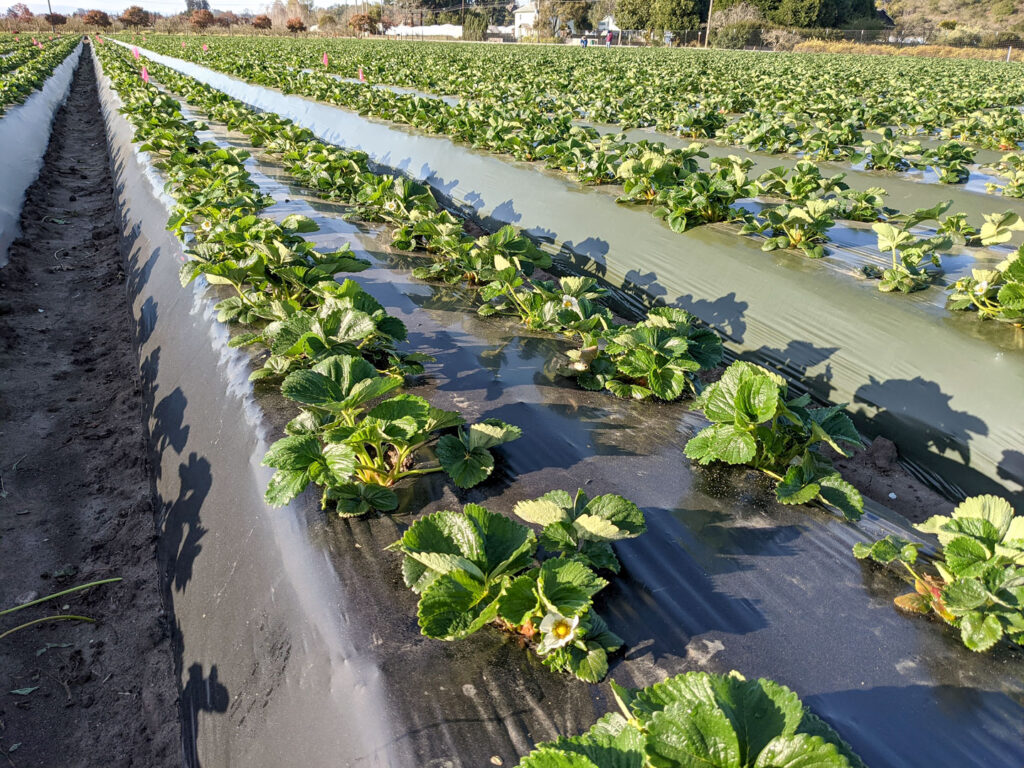
Soil-biodegradable plastic mulches (BDMs) are an alternative mulch technology designed to biodegrade in soil upon tillage through the activity of native soil microorganisms. They were created in the early 1990s as an alternative to non-degradable plastic polymers, primarily polyethylene (PE), that reduce plastic waste generation in agriculture. Functionally, BDMs should be 100% biodegradable and provide the same horticultural benefits as non-degradable mulches including weed suppression, soil temperature moderation, soil moisture retention, and overall increased yields and crop quality. BDMs should biodegrade in field soil or a composting environment and form no environmentally harmful residues.
But what is a BDM composed of and what provides the various properties in this alternative mulch? This factsheet and the List of primary ingredients that may be found in a soil-biodegradable plastic mulch provides a general list of ingredients that may be found in commercial BDMs and lists their various functions. In general, 75-95% by mass of BDM films are composed of polymeric feedstocks with the remainder being additives/minor components. Feedstocks are the primary raw material used to make a BDM and are biobased, derived from fossil fuels, or a blend of the two. Commercially available BDMs are a blend of both biobased and fossil fuel feedstocks with biobased content ranging from 10-50%. Biobased content does not correlate with biodegradability. One example of BDM created for an experiment contained 78.7% polymers, 13.3% binder (calcium carbonate), 4.4% plasticizer and processing aid, 2.0% carbon black, and 1.6% slip agent (Hayes et al., 2017). Individual mulch manufacturer formulations will vary, however, as they are proprietary and are unique to the company.
Note that a glossary of terms associated with soil-biodegradable mulches for specialty crops can also be found online.
List of primary ingredients that may be found in a soil-biodegradable plastic mulch.
Polymeric Feedstocks
Biobased – Starch
Biobased – Polylactic acid (PLA)See Notes 1
Biobased – Polyhydroxyalkanoates (PHA)
Fossil fuel – Polybutyleneadipate-co-terephthalate (PBAT) See Notes 2, 3
Fossil fuel – Poly-caprolactone (PCL)
Fossil fuel – Poly-butylene succinate (PBS) and poly-butylene succinate Adipate (PBSA) See Notes 2, 3
- Although the monomer, lactic acid, is biobased, PLA is a “synthetic” because the polymerization is performed chemically using a catalyst.
- Feedstocks prepared by some manufacturers are partially biobased; for instance, the monomers 1,4-butanediol and succinic acid.
- Low molecular weight oligomers and monomers (e.g., 1,4-butanediol and adipic acid) may be present at trace levels (< 1%).
Additives
Plasticizers
Lubricants
Fillers
Nucleating or clarifying agents
Antioxidants
UV Stabilizers
Antibacterial additives
Colorant
Pigment
References
- Arrigo, R. and N.D. Dintcheva. 2017. Natural anti-oxidants for bio-polymeric materials. Archives in Chemical Research. 1:2.
- Hayes, D.G., L.C. Wadsworth, H.Y. Sintim, M. Flury, M. English, S. Schaeffer, and A. Saxton. 2017. Effect of diverse weathering conditions on the physicochemical properties of biodegradable plastic mulches. Polymer Testing 62:454-467.
- Kang, K.S., S.I. Lee, T.J. Lee, R. Narayan, and B.Y. Shin. 2008. Effect of biobased and biodegradable nucleating agent on the isothermal crystallization of poly (lactic acid). Korean Journal of Chemical Engineering 25:599-608.
- Mitrovich, M.J., B. Lanz, and M. Molz. 2012. Biodegradable plastic based lubricant compositions. Canadian Patent CA2827702A1.
This material is based upon work that is supported by Western Sustainable Agriculture Research and Education, under award number WPDP19-05. Any opinions, findings, conclusions, or recommendations expressed in this publication are those of the author(s) and should not be construed to represent any official USDA or U.S. Government determination or policy

WSU Extension programs and employment are available to all without discrimination. Evidence of noncompliance may be reported through your local WSU Extension Office.