
In-Field Biodegradation of Soil-Biodegradable Mulch
Summary
It is important to realize that real-world, in-field conditions are different than laboratory incubations that are used to determine biodegradability. We cannot expect mulch films to degrade in the field at the same rate as in the laboratory. Thermal time can be used to estimate the amount of time needed to reach 90% biodegradation in the field.
Polyethylene (PE) mulch is widely used in horticultural crop production for weed control, soil temperature modification, soil moisture retention, earlier harvest, and improved crop quality. However, PE mulch is non-recyclable due to soil contamination after removal from the field, and thus most PE mulch is disposed of in landfills or, in some cases, buried or burned on farm. Soil-biodegradable plastic mulch (BDM) is a sustainable alternative to PE mulch. BDM provides comparable horticultural benefits to PE mulch with an added advantage of being designed to be tilled into the soil at the end of the cropping season, which reduces waste and disposal challenges. After being incorporated into the soil, BDM fragments biodegrade into carbon dioxide and water, and do not impact soil health. Despite these benefits, adoption of BDM has been slow as growers feel uncertain about in-field biodegradation.
The international biodegradability standard EN-17033 requires that all plastics that claim to be biodegradable reach 90% biodegradation within 2 years in an aerobic incubation test at a controlled temperature between 20‒28 °C (68‒82 °F). However, in-field biodegradation of BDM may take longer than in the laboratory test because seasonal variation observed in field soil temperature and moisture is not accounted for in laboratory test.
Thermal time, or cumulative degree days (°C-day) in the lab incubation has been observed to better correlate with in-field plastic mulch biodegradation than calendar time. Accumulation of degree days per unit time varies based on location, and thus depends on local climatic conditions.
Thermal time, or cumulative degree days is defined as the number of degrees the average daily temperature exceeds a base temperature (taken as 0 °C for this study).
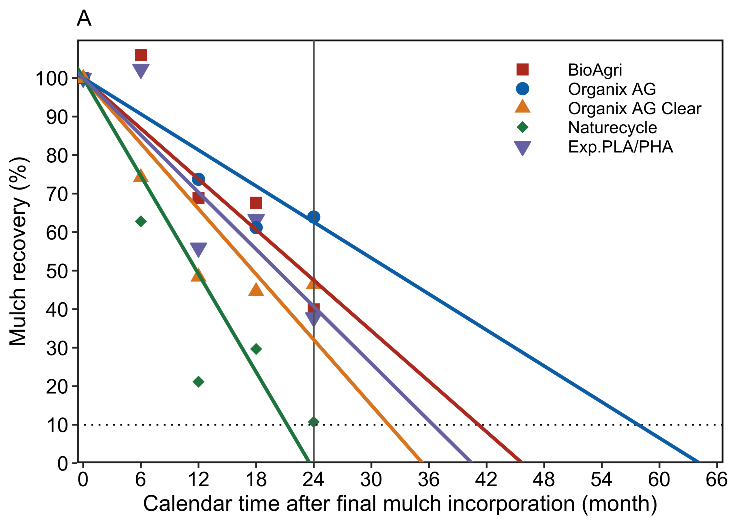
In a field experiment in Mount Vernon, WA, five BDMs were incorporated into the soil annually for four years (2015‒2018). Two years after the final incorporation, 4‒16% of the total BDMs were recovered (Fig. 1). Figure 2A shows the calendar time prediction for 90% biodegradation of each BDM under field conditions at this site (2–5.2 years).
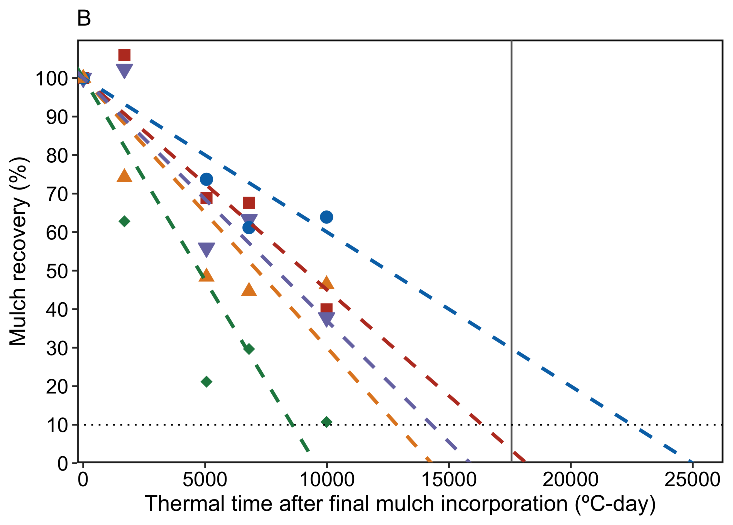
The soil biodegradation standard EN-17033 laboratory test includes incubation at 20 to 28 °C, with 14,640 to 20,496 °C-days accumulated over the 2-year period. In Mount Vernon, WA, it would take 37 and 52 months (3.1 and 4.3 years) to accumulate the same number of cumulative degree days as in the laboratory test. The field study at this location predicts it would take 21 to 58 months (1.7–4.8 years) for the five different BDMs to reach 90% BDM biodegradation at this site (Fig. 2B).
Mount Vernon, WA, Watsonville, CA, and Quincy, FL are representative climatic locations where plastic mulches are commonly used. The average annual soil temperatures are 10.3 °C in Mount Vernon, 13.5 °C in Watsonville, and 19.7 °C in Quincy. The average thermal time of the standard EN-17033 test (17,568 cumulative °C-days) for 90% BDM biodegradation would be reached in 28.3 months (2.4 years) in Quincy, 33.8 months (2.8 years) in Watsonville, and 45.5 months (3.8 years) in Mount Vernon. Faster degradation is thus expected in warmer climates.
It is important to realize that real-world, in-field conditions are different than laboratory incubations. Soil type, temperature and moisture, soil microbial communities, and mulch fragment size also affect site-specific, in-field BDM biodegradation. Therefore, we cannot expect BDMs to degrade in the field at the same rate as in the laboratory. A thermal unit calculation based on local weather data can be used to estimate the amount of time needed to reach 90% biodegradation in the field.
![Line graph showing percent recovery of BDM fragments (BioAgri, Organix AG, Organix AG Clear, Naturecycle, and Exp. PLA/PHA) collected from 2016 to 2020 (Fall [solid arrow] and Spring [dotted arrow]). Plot area shaded gray after Fall 2018. Starting recovery ranged from ~70% (Bioagri) followed by Organix AG, Organix AG Clear and Exp. PLA/PHA, to 25% (Naturecycle), with recovery % trending down sharply and ending at between 4-16% (from lowest Naturecycle, Organix AG Clear, Exp. PLA/PHA, BioAgri, Organix AG). (Exp. PLA/PHA showed an initial recovery jump before falling to join the overall trend.](https://wpcdn.web.wsu.edu/cahnrs/uploads/sites/68/2026/02/BDM-in-field-degradation_Figure1.png)
References
- ASTM-D5988, 2012. Standard test method for determining aerobic biodegradation of plastic materials in soil, D5988–12 West Conshohocken, PA.
- EN-17033, 2018. Plastics—Biodegradable mulch films for use in agriculture and horticulture— Requirements and test methods. European standard, European committee for standardization, Brussels, Belgium.
- Ghimire, S., Flury, M., Scheenstra, E.J., Miles, C.A., 2020. Sampling and degradation of biodegradable plastic and papermulches in field after tillage incorporation. Sci. Total Environ. 703, 135577.
- Hayes, D.G., Flury,M., 2018. Summary and assessment of EN 17033:2018, a new standard for biodegradable plastic mulch films. Report No. EXT-2018-01.
- Hayes, D.G.,Wadsworth, L.C., Sintim, H.Y., Flury, M., English,M., Schaeffer, S., Saxton, A.M., 2017. Effect of diverse weathering conditions on the physicochemical properties of biodegradable plastic mulches. Polym. Test. 62, 454–467.
- Sintim, H.Y., Bary, A.I., Hayes, D.G., Wadsworth, L.C., Anunciado, M.B., English, M.E., Bandopadhyay, S., Schaeffer, S.M., DeBruyn, J.M., Miles, C.A., Reganold, J.P., Flury, M., 2020. In situ degradation of biodegradable plastic mulch films in compost and agricultural soils. Sci. Total Environ. 727, 138668.
This material is based upon work that is supported by Western Sustainable Agriculture Research and Education, under award number WPDP19-05. Any opinions, findings, conclusions, or recommendations expressed in this publication are those of the author(s) and should not be construed to represent any official USDA or U.S. Government determination or policy.

WSU Extension programs and employment are available to all without discrimination. Evidence of noncompliance may be reported through your local WSU Extension Office.